
Positive Signs After Embryo Transfer: What They Mean | Damien Fertility Partners

Implantation bleeding occurs in approximately 25% of successful pregnancies — meaning most patients who go on to have healthy pregnancies experience no spotting at all. That statistic is a useful starting point for understanding why symptoms after embryo transfer are so difficult to interpret, and why the two-week wait can feel so disorienting.
The honest clinical reality is that progesterone supplementation — used in most IVF protocols — produces many of the same physical sensations as early pregnancy, making symptom tracking an unreliable measure of outcome. We’ve guided patients through this period since 1989 from our offices in Shrewsbury (Monmouth County), Newark (Essex County), and Jersey City (Hudson County). What follows is a clear, medically grounded explanation of what is happening in your body after transfer and what is worth paying attention to. Request a consultation to discuss your specific protocol and post-transfer plan with our team, including virtual appointments available with Dr. Barry Perlman.
After Embryo Transfer
After an embryo is transferred into the uterine cavity, it must hatch from its outer shell, attach to the uterine lining, and begin implantation — a process that typically unfolds over three to five days following transfer. For a day-5 blastocyst transfer, implantation most commonly occurs between days one and three post-transfer. During this window, the embryo burrows into the endometrium and establishes the cellular connections that will eventually form the placenta.
As implantation occurs, the embryo begins producing human chorionic gonadotropin (hCG) — the hormone detected by pregnancy tests. hCG levels start very low but rise rapidly in a successful pregnancy, roughly doubling every 48–72 hours in the early weeks. That rise in hCG triggers a cascade of hormonal changes that can produce physical symptoms. However, many of these overlap significantly with the effects of progesterone supplementation, which is why symptom interpretation during this period has limited clinical value as a standalone measure.
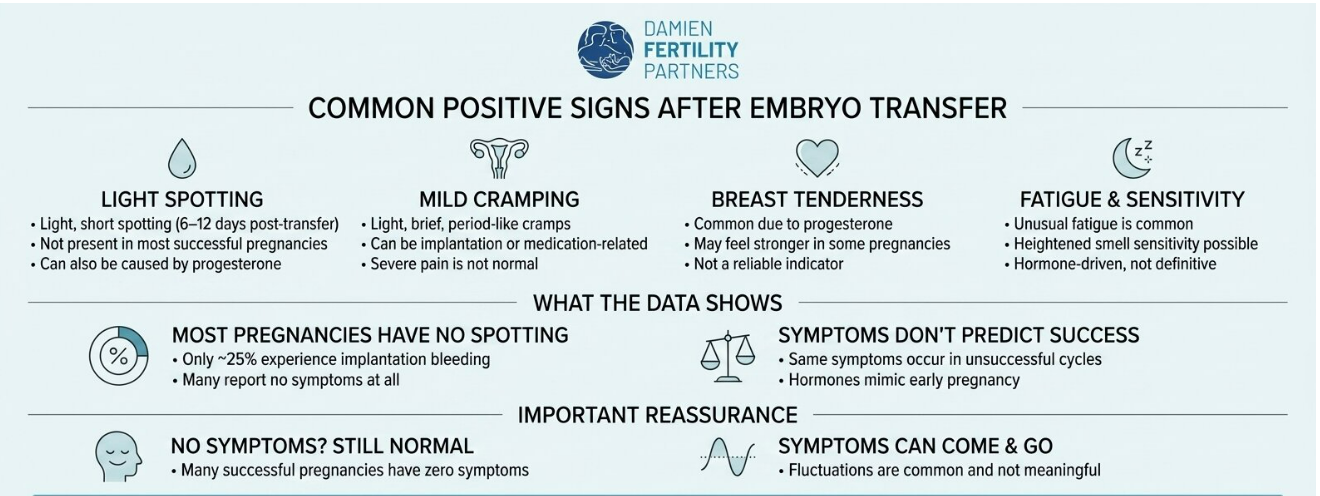
Commonly Reported Symptoms in Successful Cycles
Light spotting. Light spotting — sometimes called implantation bleeding — can occur when the embryo embeds in the uterine lining, causing minor disruption to small blood vessels. It typically appears 6–12 days after transfer and is lighter and shorter than a menstrual period. It occurs in roughly 25% of successful pregnancies. Progesterone can also cause light spotting, which further limits its predictive value.
Mild cramping and pelvic pressure. Mild cramping or pelvic heaviness is common after embryo transfer and may reflect implantation activity, uterine response to the transfer itself, or the effects of hormonal medications. It is usually light and short-lived — similar to or milder than menstrual cramps. Severe or worsening pain is not typical and should be reported to your care team promptly.
Breast tenderness. Breast tenderness is common in both successful and unsuccessful IVF cycles, largely driven by progesterone. Some patients who become pregnant notice greater intensity or longer duration, but this distinction is subtle and not reliable for predicting outcome. It is worth noting if it feels meaningfully different from previous cycles.
Fatigue. Unusual fatigue — disproportionate to activity level — is frequently reported in the early post-transfer period. Rising progesterone contributes to fatigue regardless of outcome; in successful pregnancies, rising hCG adds to that effect. Fatigue is not a reliable standalone indicator, but its presence alongside other symptoms may be worth noting.
Heightened sensitivity to smells. Heightened olfactory sensitivity is a commonly reported early pregnancy symptom driven by the hormonal environment of rising hCG. Like fatigue, it can appear in the first week post-transfer in successful cycles, though it is not specific enough to serve as a reliable indicator on its own.
What Symptoms Cannot Tell You
No symptom — or combination of symptoms — can reliably predict whether an embryo transfer has succeeded. Cramping, spotting, breast tenderness, and fatigue are all equally common in unsuccessful cycles due to progesterone supplementation. Studies consistently show that symptom presence or absence during the two-week wait does not correlate meaningfully with outcome.
The only reliable measure is a beta-hCG blood test, which your care team will schedule at the appropriate time after transfer. At Damien Fertility Partners, that test is timed to your specific transfer date and protocol — the nursing team reviews all results directly with patients.
The Absence of Symptoms
Many patients become concerned when they feel completely normal after transfer. The absence of symptoms does not indicate that implantation has not occurred. A significant proportion of patients who go on to have successful pregnancies report feeling no different during the two-week wait. The hormonal environment during this period is complex, and individual responses vary considerably.
It is also common for early symptoms to be intermittent — present one day and absent the next. This fluctuation is not a reliable indicator of pregnancy loss. Early hCG levels are low and rising, and the body’s response to those levels is not always consistent day to day. If symptoms that were previously present disappear completely and abruptly, it is worth mentioning to your care team — but on its own, it is not a definitive sign of a failing pregnancy.
The Two-Week Wait: Managing the Waiting Period
Most fertility specialists — including the American Society for Reproductive Medicine — advise against taking home pregnancy tests before your scheduled beta-hCG blood test. Home tests detect hCG, but in the earliest days post-transfer, hCG levels may be too low to register even in a successful cycle. A negative result before your official test date is a common source of distress that does not accurately reflect outcome.
Gentle, restorative activity during the two-week wait is appropriate for most patients. Light walking, adequate sleep, and regular nutrition are reasonable. Strenuous exercise and activities that raise core body temperature significantly are generally discouraged in the immediate post-transfer period; your care team will provide specific guidance based on your protocol.
Certain symptoms warrant prompt contact with your clinic: heavy bleeding beyond light spotting, severe or escalating pelvic pain, fever, or significant shortness of breath. Any of these may indicate a complication requiring medical attention and should not be monitored at home. Our team is available throughout the post-transfer period to answer questions and address concerns — you will always reach someone who knows your case.
Post-Transfer Care at Damien Fertility Partners
Post-transfer support is a defined part of every IVF cycle we manage. Our team coordinates beta-hCG testing, reviews results with you directly, and provides clear guidance through the waiting period and beyond. Dr. Damien — board-certified in REI by the American Board of Obstetrics and Gynecology and trained at Dartmouth Medical School with fellowships at Harvard Medical School and the University of Connecticut — has guided patients through this process for over 35 years.
Our 2023 SART live-birth rate per new patient under 35 was 81.8%, with a 100% elective single embryo transfer (eSET) rate in that group. Clinic-to-clinic comparisons should be interpreted with caution due to differences in patient populations. View our full success rates for additional context.
For patients considering IVF or currently in treatment, the innovative technology we use — including CHLOE by Fairtility, an AI-powered embryo assessment system in our embryoscope time-lapse incubators — supports embryo selection before transfer with continuous imaging data rather than static snapshots.
Request a consultation with Dr. Damien or Dr. Perlman at our Shrewsbury, Newark, or Jersey City offices — or virtually with Dr. Perlman — to discuss your IVF protocol and what to expect after transfer. Schedule your appointment here or call (732) 758-6511.
Frequently Asked Questions
1. When do implantation symptoms typically start after embryo transfer?
For a day-5 blastocyst transfer, implantation most commonly occurs between days one and three post-transfer. Any associated symptoms — light spotting or mild cramping — may appear during this window, though many patients experience nothing. Symptoms related to rising hCG, such as fatigue or breast tenderness, may become more noticeable toward the end of the first week post-transfer if implantation has occurred.
2. Can I take a home pregnancy test after embryo transfer?
Most fertility specialists advise waiting until your scheduled beta-hCG blood test before testing at home. hCG levels in the earliest days after transfer may be too low to register on a home test even in a successful cycle, and a false negative before your official test date is a common source of confusion. Your care team will provide a specific test date based on your transfer day and protocol.
3. Is cramping after embryo transfer normal?
Mild, intermittent cramping in the days after transfer is common and may result from the procedure itself, uterine activity during implantation, or progesterone supplementation. Light cramping that is similar to or milder than menstrual cramps is generally not cause for concern. Severe or worsening pain should be reported to your care team promptly.
4. What if I have no symptoms — does that mean the transfer failed?
No. Many patients who go on to have successful pregnancies report feeling completely normal during the two-week wait. The absence of symptoms is not a reliable indicator of outcome. The only definitive measure is your beta-hCG blood test, which measures the hormone produced by a developing pregnancy.
5. How long after transfer is the beta-hCG test performed?
Most clinics schedule the beta-hCG test approximately 10–14 days after a day-5 blastocyst transfer, or 12–16 days after a day-3 transfer. At Damien Fertility Partners, your test is timed to your specific transfer date and protocol. Your care team provides a clear timeline from the moment transfer is complete.
6. What does a low beta-hCG result mean?
A low but positive beta-hCG — sometimes called a “weak positive” — means hCG is detectable but at a lower level than typical. What matters most is whether that level rises appropriately over 48–72 hours. Your care team will schedule a repeat test to assess the trajectory, which provides far more information than a single value in isolation.