
Can an Ovarian Cyst Cause Infertility?

An ovarian cyst can cause infertility in some cases, though the majority never affect a woman’s ability to conceive. What decides it is the type of cyst, its size, and whether it signals a larger problem with ovarian function.
Functional cysts, the most common kind, usually disappear within one to three menstrual cycles and leave ovarian function untouched. An endometrioma does the opposite, lowering egg reserve, often showing up as a reduced AMH level. Both get labeled as cysts on an ultrasound report, yet each affects fertility in a very different way.
At Damien Fertility Partners, ovarian cysts are evaluated and treated across three New Jersey locations in Shrewsbury, Newark, and Jersey City. The practice runs its own minimally invasive surgical team and an evaluation and diagnosis program, so a patient with a cyst finding receives the full clinical picture in one place, without first needing a referral to an outside specialist.
If you have been told you have an ovarian cyst and you are worried about your fertility, the How to Begin page explains what a first fertility evaluation here involves.
The Answer Hinges on the Type of Cyst
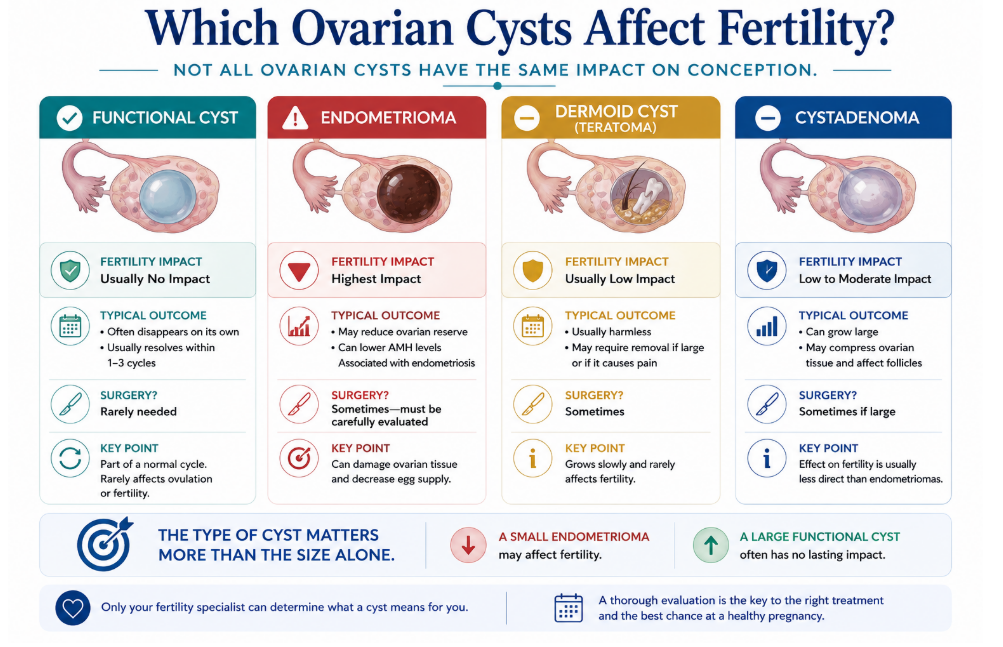
Functional cysts are the most common type, and the least concerning. Endometriomas are the opposite: of the benign cyst types, they pose the greatest threat to fertility.
Dermoid cysts and cystadenomas land somewhere in the middle, usually harmless unless they grow large. Polycystic ovary syndrome belongs in a separate category. It produces small follicles that get described as cysts on a scan, but PCOS is a hormonal disorder, not a structural one, and it is managed on entirely different terms.
So the first job in any fertility assessment involving a cyst is figuring out which kind you are dealing with, and what it is doing to the ovary around it.
Functional Cysts: The Kind That Almost Never Cause Trouble
These form as part of a normal menstrual cycle and come in two kinds. A follicular cyst develops when a follicle fails to release its egg and keeps filling with fluid instead. A corpus luteum cyst develops after ovulation, when the empty follicle seals over and retains fluid rather than dissolving as it should.
In most women, they shrink and disappear within one to three cycles, with no treatment and no lasting effect. They do not erode ovarian tissue, they rarely block ovulation or conception, and their presence says nothing about the health of your egg supply.
Timing is the only situation where they complicate fertility care. A large one present at the start of an IVF stimulation cycle can blunt how the ovaries respond to the medication, so a physician may hold off a cycle to let it clear before beginning. Outside of fertility treatment, the standard approach is to monitor with a follow-up ultrasound rather than intervene.
Endometriomas: The Cyst Most Likely to Affect Fertility
An endometrioma forms when endometrial tissue, the kind that normally lines the uterus, grows on the ovary and bleeds with every cycle. That trapped blood darkens and thickens over time, which is why these are sometimes called chocolate cysts.
They damage fertility two ways at once. First, they take up room on the ovary that would otherwise hold follicles. Second, and more serious, the inflammation they create destroys primordial follicles in the surrounding tissue. Primordial follicles are the earliest form of an egg, and they are the whole of a woman’s egg supply. Once they are gone, the body does not make more.
This drop in egg reserve shows up in the numbers that fertility doctors track. A systematic review in Reproductive BioMedicine Online found that women with endometriosis, especially those with an ovarian endometrioma, had lower AMH and antral follicle counts and higher FSH, all signs of a shrinking egg reserve. The drop tends to track with how large the cyst is and how long it has been there.
Surgery is where it gets genuinely hard. Removing an endometrioma by laparoscopy can ease symptoms and open up access to the follicles underneath, but the cyst wall is fused to healthy ovarian tissue.
Even a careful surgeon can take some follicle-bearing tissue along with the cyst, and AMH levels often fall after excision. For a woman whose reserve is already low, that is a real risk to weigh, and it is why an AMH measurement belongs on the table before any decision to operate.
Other Cyst Types and What They Mean for Fertility
Dermoid cysts, also called teratomas, are benign growths made up of tissue from several cell types, sometimes including hair, skin, and even teeth. They grow slowly and rarely affect fertility unless they become very large or trigger ovarian torsion, in which the ovary twists on its own ligaments and loses its blood supply. Removal is usually advised once they pass 5 to 6 centimeters, and the goal during surgery is to spare as much healthy ovarian tissue as possible.
Cystadenomas are fluid-filled cysts that grow off the surface of the ovary. They can get big, and a large one can press on the ovary and disrupt normal follicle development. Serous cystadenomas tend to stay smaller; mucinous ones can grow substantially. They are typically removed once they reach a size where that compression becomes a concern, though their effect on fertility is usually less direct than an endometrioma’s.
The fibroids blog post covers a related question: how structural findings in the pelvis, fibroids and cysts alike, get sorted out as part of a full fertility workup.
When Surgery Is the Right Call, and When It Is Not
Not every ovarian cyst needs to be removed before trying to conceive, and with some, removal does more harm to fertility than leaving the cyst in place.
Functional cysts are rarely operated on. Surgery is considered only if one persists beyond three or four cycles, enlarges significantly, or causes pain. The majority resolve without any intervention.
Endometriomas are the most difficult decision in this area. For a woman who has not yet begun fertility treatment, the recommendation depends on the size of the cyst, her AMH level, the severity of her symptoms, and whether IVF is planned.
Some reproductive endocrinologists proceed directly to IVF and leave the endometrioma in place, to avoid further reducing an already diminished reserve. Others recommend drainage or partial removal to improve access to follicles during retrieval. No single protocol applies, so the decision is made individually, based on each patient’s reserve, symptoms, and goals.
Surgical evaluation before fertility treatment is generally recommended for dermoid cysts larger than 5 to 6 centimeters, cystadenomas large enough to compress the ovary, and any cyst whose ultrasound features suggest a more complex process.
At Damien Fertility Partners, minimally invasive gynecologic surgery is performed in-house, at Riverview Medical Center, Monmouth Medical Center, Hackensack University Medical Center, and three other affiliated facilities. Patients are not handed off to a separate surgeon, so the same team stays with them through diagnosis, surgery, and treatment.
How a Cyst Gets Evaluated Before Treatment
When a cyst is identified, the evaluation begins with a transvaginal ultrasound to characterize it: its size, internal structure, whether it is simple or complex, and its relationship to the surrounding ovarian tissue.
Hormone testing follows, including AMH to assess ovarian reserve, along with FSH and estradiol, drawn on cycle days 2-4, as outlined on the evaluation and diagnosis page. When PCOS is a consideration, androgen and insulin panels are added.
Together, imaging and reserve markers provide the physician with what is needed to make the distinction that matters most: whether the cyst requires treatment before fertility care can proceed or can be monitored while treatment proceeds.
What to Do If You Have Been Told You Have an Ovarian Cyst
A cyst on an ultrasound is not automatically a fertility problem. It is a piece of information, and it belongs with a reproductive endocrinologist who can read it against your hormone levels, your age, and what you are trying to achieve.
Damien Fertility Partners handles ovarian cyst evaluation and treatment across its New Jersey offices in Shrewsbury, Newark, and Jersey City. Your care stays within one practice from the first evaluation through any surgery and into fertility treatment, without the handoffs that come with outside referrals.
Virtual consultations are available if you want to talk through a recent finding before coming in.
Frequently Asked Questions
1. Can you get pregnant with an ovarian cyst?
Yes, in most cases. Functional cysts, dermoid cysts, and small cystadenomas rarely stop conception, and plenty of women with these findings conceive without any intervention. Endometriomas are the exception, since they are tied to reduced ovarian reserve and lower pregnancy rates, and how they are managed before conception needs an individual assessment.
2. Do ovarian cysts need to be removed before IVF?
Not always. Functional cysts often clear on their own before the next stimulation cycle starts. For endometriomas, it depends on the cyst’s size, current AMH level, and symptom severity. Some patients go ahead with IVF with the cyst still in place; others do better with surgery first. There is no universal protocol, and the call is based on the individual patient’s reserve and history.
3. How does an endometrioma affect ovarian reserve?
An endometrioma lowers ovarian reserve in two ways: the space it occupies displaces follicle-bearing tissue, and the inflammation it produces destroys primordial follicles in the surrounding cortex. Research consistently finds lower AMH levels in women with endometriomas than in women the same age without them, and the decline tracks with cyst size and how long it has been present.
4. What size ovarian cyst affects fertility?
Size is one factor, not the whole story. A small endometrioma of 2 to 3 centimeters can meaningfully cut into ovarian reserve, while a much larger functional cyst may leave no lasting mark at all. For most cyst types, the kind of cyst, what it looks like inside, and how close it sits to healthy ovarian tissue matter more than size by itself.
5. Will removing an ovarian cyst improve fertility?
It depends on the type and the surgical approach. Removing a dermoid cyst or cystadenoma that is pressing on the ovary can restore normal access to the follicles. For endometriomas, removal may improve access during IVF retrieval but carries a risk of lowering ovarian reserve if healthy tissue comes out with the cyst wall, which is why AMH should be measured first to set a baseline.
6. How is an ovarian cyst diagnosed?
Transvaginal ultrasound is the main tool. It pins down the cyst’s size, structure, and how it relates to the tissue around it. When fertility is the concern, hormone tests like AMH and cycle-day FSH are usually added to show how the cyst may be affecting ovarian reserve alongside imaging findings.