
What Is a Euploid Embryo and Why Does It Matter for IVF?

A euploid embryo has the correct number of chromosomes: 46, arranged in 23 pairs. That count is the single biggest reason one embryo gets transferred and another stays frozen. Most failed transfers and early miscarriages trace back to the wrong number of chromosomes, which is why a euploid result changes the odds more than almost anything else a lab can tell you about an embryo.
Damien Fertility Partners screens for chromosomal status through preimplantation genetic testing as part of its IVF protocols across three New Jersey locations in Shrewsbury, Newark, and Jersey City.
Testing alone is only half the picture, so the lab pairs it with the CHLOE AI monitoring system, which tracks how each embryo grows. A transfer decision then rests on both the chromosome count and the embryo’s development, not on how the embryo looks under a microscope.
If you want to see how that track record holds up before booking a consultation, the practice reports its outcomes through the SART database.
What Euploid Actually Means
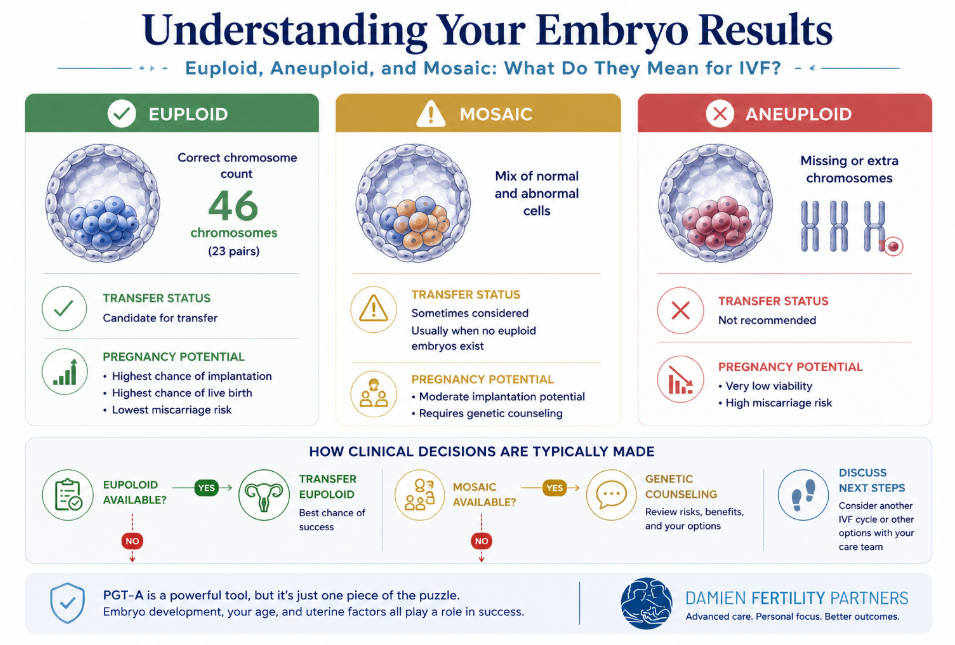
Human cells contain 46 chromosomes arranged in 23 matching pairs. One chromosome in each pair comes from the egg, one from the sperm. When an embryo has exactly this count, with no extra or missing copies, it is euploid. An embryo with too many or too few is aneuploid. One carrying a mix of normal and abnormal cells is mosaic, sitting between the two and bringing its own clinical considerations.
Euploid describes the chromosome count and nothing else. It does not measure how well the embryo grew, its mitochondrial health, or whether the uterine lining is ready to receive it. All of those affect whether a transfer works, and a clean PGT-A result speaks to none of them.
How an Embryo Gets the Euploid Designation
The euploid designation comes from preimplantation genetic testing for aneuploidy (PGT-A). The test is performed at the blastocyst stage, typically Day 5 or Day 6 of embryo development, when the embryo has differentiated into two distinct cell populations: the inner cell mass, which becomes the fetus, and the trophectoderm, which becomes the placenta.
A biopsy removes 5 to 8 cells from the trophectoderm layer. Sampling placental tissue rather than fetal cells reduces the risk of disrupting the embryo’s developmental potential. The biopsied cells go to a genetics laboratory, where next-generation sequencing counts and analyzes all 46 chromosomes across all 23 pairs.
Results return as euploid, aneuploid, or mosaic. The embryo itself is cryopreserved throughout and remains frozen until results are received, and a transfer decision is made with the patient. The existing PGT overview on the Damien Fertility Partners blog covers the three PGT test types in detail for patients who want broader context.
Why Chromosomal Status Is the Single Strongest Predictor of Transfer Outcome
Chromosomal aneuploidy is the leading cause of failed IVF transfers and early miscarriage. When an aneuploid embryo implants, it typically either fails to develop past the earliest stages of pregnancy or results in a miscarriage, often before the patient knows a pregnancy was established.
Transferring a tested euploid embryo substantially improves the per-transfer success rate compared to transferring an untested embryo. In a single-center analysis of good-prognosis patients under 35 years of age, published in the Journal of Assisted Reproduction and Genetics, the live birth rate per euploid blastocyst was 70.0% compared with 52.5% for untested blastocysts, a difference of 17.5 percentage points.
The practical payoff is fewer failed transfers before a pregnancy that sticks, which spares patients both the cost and the emotional toll of repeating cycles.
For patients who have experienced recurrent implantation failure or recurrent pregnancy loss, identifying a euploid embryo for transfer removes the chromosomal variable from an already complex clinical picture.
Euploid, Aneuploid, and Mosaic: What Each Result Actually Means
A euploid result means all 23 pairs of chromosomes came back normal, which makes the embryo a candidate for transfer.
An aneuploid result means one or more chromosomes showed an extra copy (trisomy) or a missing copy (monosomy) across the full chromosome panel. Embryos with this result are not transferred, because they rarely lead to a healthy pregnancy and usually end in miscarriage. There are exceptions. A few aneuploidies, trisomy 21 among them, can produce a live birth, but most cannot.
A mosaic result indicates the embryo contains a mixture of chromosomally normal and abnormal cells. Mosaicism is reported on a spectrum based on the proportion of abnormal cells detected in the biopsy sample.
Current clinical guidance from the Preimplantation Genetic Diagnosis International Society recommends that mosaic embryos may be considered for transfer when no euploid embryos are available, with embryos carrying a lower proportion of abnormal cells prioritized over those carrying a higher proportion.
Live births have been reported from mosaic embryo transfers, though success rates are lower than for fully euploid embryos and genetic counseling is standard practice before proceeding.
How Age Affects Your Chances of Having a Euploid Embryo
Egg age is the primary driver of chromosomal abnormalities in embryos. As eggs age, the mechanism that separates chromosomes during cell division becomes less precise, producing higher rates of aneuploidy in the resulting embryos.
The clinical data are consistent. Franasiak and colleagues, in a review of 15,169 trophectoderm biopsies published in Fertility and Sterility in 2014, found that aneuploidy reached its lowest point near age 26 and rose steadily after the mid-30s. In practical terms, roughly half of blastocysts test euploid in women under 35, that proportion falls to about a third by the late 30s, and it drops below 20% by the mid-40s.
This age relationship explains why older patients often need more retrieval cycles to accumulate enough euploid embryos for transfer. It also explains why egg freezing at a younger age can produce more chromosomally normal embryos than a cycle done at the time of intended use.
The chromosome clock runs with the eggs, not the uterus. A 43-year-old uterus can carry a pregnancy from a euploid embryo created at 32 at essentially the rate it would have years earlier.
What Euploid Does Not Guarantee
Euploid is a necessary condition for a viable pregnancy, not a sufficient one. Chromosomally normal embryos sometimes fail to implant, and they miscarry at a lower rate than aneuploid embryos but not at zero.
Endometrial receptivity, uterine anatomy, and immune and thrombophilic factors all influence whether a euploid embryo results in an ongoing pregnancy. Endometrial receptivity refers to the uterine lining’s readiness to accept an embryo on the day of transfer. Structural abnormalities such as fibroids or polyps can interfere with implantation even when the embryo itself is chromosomally normal.
This is where chromosomal status and developmental quality become two separate, complementary data points. A PGT-A result tells you the embryo has the right number of chromosomes. It says nothing about how that embryo grew.
At Damien Fertility Partners, embryo development is continuously monitored by the CHLOE AI system from Fairtility alongside PGT-A results. CHLOE tracks morphokinetic markers, meaning the precise timing and pattern of each cell division event throughout the blastocyst culture period.
The practical value of pairing the two is selection. Among several euploid embryos, the one that also divided on a normal morphokinetic timeline is a stronger transfer candidate than one whose division pattern was off. PGT-A narrows the pool to chromosomally normal embryos; morphokinetic data help the physician rank the remaining embryos.
Thinking Through PGT-A for Your Cycle
PGT-A is not the right choice for every patient or every cycle. For younger patients with a high number of blastocysts and no history of recurrent loss or implantation failure, the added cost and the small biopsy risk may not meaningfully change outcomes, since most blastocysts in that age group are already euploid.
For patients over 38, those with recurrent pregnancy loss, or those with a history of failed transfers, identifying euploid embryos before transfer reduces the number of cycles needed and the combined emotional and financial cost of repeated attempts.
Damien Fertility Partners offers genetic testing as part of IVF protocols across its New Jersey locations in Shrewsbury, Newark, and Jersey City.
Whether PGT-A belongs in your protocol depends on your age, cycle history, and how many embryos your retrieval produces. Your physician will work through those specifics with you. If you have not yet had that conversation, an initial consultation is where it begins.
Frequently Asked Questions
1. What is the difference between a euploid and a normal embryo?
A euploid embryo and a chromosomally normal embryo are the same thing: both describe an embryo with 46 chromosomes in 23 correct pairs. “Normal” is the plain language version; “euploid” is the clinical term used in PGT-A reports. An embryo can appear morphologically normal under a microscope and still be aneuploid, which is why chromosomal testing provides information that visual grading alone cannot.
2. Does a euploid embryo always lead to a successful pregnancy?
No. Euploid embryos have substantially higher implantation and live birth rates than untested or aneuploid embryos, but they do not implant in every case. Endometrial receptivity, uterine anatomy, immune factors, and embryo-specific developmental quality all influence whether a euploid embryo results in an ongoing pregnancy.
3. What percentage of embryos are euploid?
The proportion of euploid embryos varies significantly with maternal age. Drawing on Franasiak and colleagues’ 2014 review of 15,169 biopsies, roughly half of blastocysts test euploid in women under 35, dropping to about a third by the late 30s and below 20% by the mid-40s. These are population-level estimates; individual results vary based on ovarian reserve and cycle conditions.
4. Should I do PGT-A if I am under 35?
For younger patients with strong ovarian reserve and no history of recurrent loss or failed transfers, PGT-A may add cost without meaningfully changing outcomes, since the majority of blastocysts in that age group are already euploid. The decision depends on how many blastocysts were produced, the patient’s preference for single embryo transfer, and whether any prior transfers have failed. This is best worked through with your reproductive endocrinologist using your specific numbers.
5. What happens to aneuploid embryos?
Aneuploid embryos are not recommended for transfer because the probability of a viable ongoing pregnancy is very low and the risk of miscarriage is high. They remain cryopreserved unless the patient elects to discard them or donate them to research. Clinics do not transfer aneuploid embryos without explicit informed consent and a full discussion of the associated risks.
6. Can a mosaic embryo result in a healthy baby?
Yes. Live births have been reported following transfer of mosaic embryos, particularly those with a lower proportion of abnormal cells. Success rates are lower than for fully euploid embryos, and the clinical recommendation is to consider mosaic transfers only when no euploid embryos are available. Genetic counseling before a mosaic transfer is standard practice to ensure patients understand the range of possible outcomes.