
Gestational Carrier vs. Surrogate: What’s the Difference?

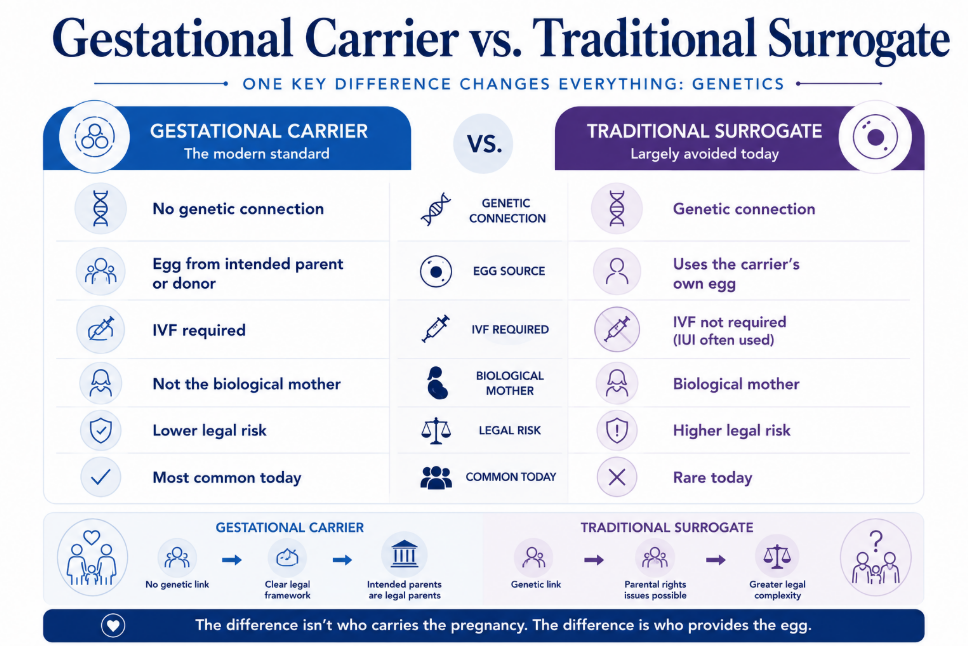
A gestational carrier has no genetic link to the baby she carries. A traditional surrogate does. That single distinction changes the genetics, the medical process, and, most consequentially, who the law recognizes as the parent. Intended parents who understand it before starting save themselves from a category of legal risk that is difficult to undo later.
Damien Fertility Partners works with intended parents and gestational carriers across three New Jersey locations in Shrewsbury, Newark, and Jersey City. The practice handles the medical side of gestational carrier IVF, including embryo creation, carrier preparation, and transfer, while surrogacy agencies and mental health professionals support the rest of the arrangement. If you are researching third-party reproduction options, the How to Begin page explains what a first consultation covers.
Where the Two Arrangements Split
In a gestational carrier arrangement, the embryo placed in the carrier’s uterus is created through IVF using eggs from the intended mother or a donor and sperm from the intended father or a donor. The carrier gestates and delivers the baby. She is not the biological mother.
In a traditional surrogacy arrangement, the woman carrying the pregnancy also supplies the egg. She is both the gestational and biological mother of the child. That genetic tie is what separates the two arrangements legally and ethically, and it is the reason traditional surrogacy has nearly disappeared from current practice.
Traditional Surrogacy: How It Worked and Why It Faded
Traditional surrogacy is older than IVF. Before the first successful IVF birth in 1978, no one could transfer an embryo conceived outside the body, so any surrogacy required the carrier’s own egg. Conception happened through intrauterine insemination with sperm from the intended father or a donor, which made the carrier the biological mother from the point of fertilization.
When IVF opened the door to gestational carrier arrangements, traditional surrogacy fell off sharply. The reasons are mostly legal.
A traditional surrogate is genetically related to the child, so in many jurisdictions she holds biological parental status regardless of any contract signed beforehand. The 1988 New Jersey Supreme Court ruling in In re Baby M, the most cited traditional surrogacy dispute in US legal history, came out of exactly this conflict: a surrogate who had provided her own egg sought parental rights over the child she carried. The court found the surrogacy contract unenforceable and granted her visitation, which showed that contractual intent does not override a biological parentage claim.
That case still matters to New Jersey intended parents because it shaped how the state later wrote its surrogacy law. Today most reproductive attorneys, clinics, and agencies steer clients away from traditional surrogacy. No contract can erase the parental claim of a carrier who contributed the egg, and the exposure for intended parents is real.
Gestational Carrier: The Modern Standard
A gestational carrier contributes no egg, so she has no biological claim to the child. The intended parents’ relationship to the baby runs through the embryo itself, which removes the legal problem at the center of traditional surrogacy. These arrangements became widely available as IVF matured in the early 1980s, and they now account for the large majority of surrogacy in the United States.
From the carrier’s side, the medicine is uncomplicated. She follows an endometrial preparation protocol, the same one used in a frozen embryo transfer cycle, with estrogen to build the uterine lining and progesterone to time the transfer. The transfer takes about 10 to 15 minutes and needs no anesthesia. She has no part in egg retrieval or ovarian stimulation, which the intended mother or egg donor completes separately before her cycle begins.
When the intended mother’s eggs cannot be used, the cycle proceeds with donor eggs. That pairing is common for intended mothers of advanced reproductive age, for gay male couples, and for single men, all of whom need both a carrier and a donor egg to have a genetically related child.
How the Legal Frameworks Differ
The legal gap between the two arrangements decides who holds parental rights at birth, not just how the paperwork is processed.
For gestational carrier arrangements, a contract reviewed by a reproductive attorney and signed before any treatment starts names the intended parents as the legal parents. New Jersey’s Gestational Carrier Agreement Act, enacted in 2018, built a specific statutory framework for this. Under that law, intended parents can obtain a parentage order before birth, settling their rights ahead of delivery, and the carrier holds none.
No comparable statute covers traditional surrogacy in New Jersey, and Baby M established that a contract cannot override a biological mother’s claim. Intended parents in a traditional arrangement carry a risk that gestational carrier arrangements were designed to remove. The 2018 law is a major reason New Jersey ranks among the more favorable states for gestational carrier arrangements, as it spells out protections that many states still lack.
Why the Word You Use Matters
Reproductive medicine professionals increasingly avoid the word “surrogate” on its own because it blurs two arrangements with different legal and medical profiles. When a physician, attorney, or agency uses the term “surrogate,” you often cannot tell whether they mean a traditional surrogate or a gestational carrier.
“Gestational carrier” carries more information. It tells everyone that the arrangement uses IVF, that the carrier has no genetic tie to the child, and that the governing legal framework differs from traditional surrogacy. Asking agencies, attorneys, and clinics specifically about gestational carrier arrangements and confirming that none of the carrier’s eggs will be used clarifies ambiguity early and keeps all parties working from the same set of rules.
Understanding Your Options at Damien Fertility Partners
Most intended parents pursuing third-party reproduction today choose gestational carrier IVF over traditional surrogacy. The legal protections hold up better, the medical process is well-established, and the genetic link between intended parents and the child is clear from the start.
Damien Fertility Partners provides gestational carrier IVF across its New Jersey offices in Shrewsbury, Newark, and Jersey City. One physician oversees the full IVF cycle and follows each patient from the first consultation through embryo creation and the carrier’s transfer. Monitoring visits during the cycle may be handled by Nurse Practitioners Gloria Lopez or Elizabeth Piercy, both AANP-certified FNPs on the care team, while procedural appointments remain with the physician. The practice serves a wide range of intended parents, including LGBTQ+ families and single parents.
If you are weighing a gestational carrier arrangement and want to understand the medical and legal steps before choosing an agency, a consultation with Damien Fertility Partners is a practical first move. Virtual consultations are available for intended parents who want to start the conversation before committing to a clinic or agency.
Frequently Asked Questions
1. Is a gestational carrier the same as a surrogate?
Not exactly. “Surrogate” is a general term that can mean either a gestational carrier or a traditional surrogate, depending on who is speaking. A gestational carrier has no genetic tie to the baby, since the embryo comes from the intended parents’ or donors’ genetic material through IVF. A traditional surrogate uses her own egg and is the biological mother. Gestational carrier arrangements are the standard today, and traditional surrogacy is rare.
2. Why is traditional surrogacy rarely used today?
It exposes intended parents to legal risk, because the surrogate is also the biological mother. In the United States, biological parentage carries weight that a contract cannot fully override. The 1988 New Jersey ruling in In re Baby M proved this when a traditional surrogate won parental rights despite a signed agreement. Most attorneys and clinics now recommend gestational carrier arrangements to avoid that outcome.
3. Does a gestational carrier have parental rights?
In New Jersey, no. Under the Gestational Carrier Agreement Act of 2018, a properly executed agreement names the intended parents as the legal parents, and the carrier holds no parental rights. A parentage order obtained through the New Jersey courts before delivery confirms that status before the baby is born.
4. What medical procedure does a gestational carrier undergo?
She follows an endometrial preparation protocol using estrogen and progesterone to ready the uterine lining, then has an embryo transfer that takes about 10 to 15 minutes and needs no anesthesia. She takes no part in egg retrieval or ovarian stimulation. The intended mother or an egg donor completes those steps separately before her cycle begins.
5. Can gay male couples or single men use a gestational carrier?
Yes, and it is the standard path to a genetically related child for them. Because neither party can provide eggs, the arrangement also calls for a donor egg. Damien Fertility Partners coordinates both parts, including donor egg selection and cycle synchronization, through its gestational carrier IVF program and LGBTQ+ family building services.