
What Is a Gestational Carrier? A Guide for Intended Parents

A gestational carrier is a woman who carries and delivers a pregnancy for intended parents using an embryo she has no genetic connection to. She is not the biological mother of the child. The embryo transferred to her uterus was created through IVF from the intended parents’ eggs and sperm, or from donor gametes, and she is compensated for her role in carrying the pregnancy.
Damien Fertility Partners works with gestational carriers and intended parents across three New Jersey locations in Shrewsbury, Newark, and Jersey City. The practice manages the full medical component of gestational carrier IVF, from embryo creation and carrier endometrial preparation through transfer and early pregnancy monitoring, alongside agency partnerships and mental health professionals who support the matching and relational dimensions of the arrangement.
If you are an intended parent considering this path, the How to Begin page outlines what an initial consultation involves and what your physician will review to assess your candidacy for gestational carrier IVF.
What a Gestational Carrier Is and Is Not
The term “gestational carrier” is distinct from “surrogate” in one clinically and legally significant way: a gestational carrier has no genetic relationship to the baby she carries. The embryo transferred to her uterus belongs entirely to the intended parents or their donors. She gestates the pregnancy and delivers the child. Her own eggs are not involved.
A traditional surrogate contributes with her own egg, making her the biological mother of the child. Traditional surrogacy is largely avoided in contemporary reproductive medicine because the biological connection creates substantial legal complications around parental rights that gestational carrier arrangements do not carry.
The gestational carrier’s role is purely gestational. She is not a co-parent, a donor, or a party to the child’s genetic lineage. In New Jersey, the Gestational Carrier Agreement Act, enacted in 2018, makes this legal distinction explicit and provides a statutory framework that protects the rights of all parties before the pregnancy begins.
Who Qualifies to Be a Gestational Carrier
Gestational carriers go through a formal qualification process managed by the surrogacy agency and the fertility clinic before any transfer proceeds. The requirements exist to protect the carrier’s health, the pregnancy, and the intended parents’ investment of time and resources.
Most surrogacy agencies and fertility clinics require gestational carriers to be between 21 and 40 years old, have completed their own family, and have had at least one prior uncomplicated pregnancy and delivery. This prior pregnancy requirement is not arbitrary: it confirms the carrier’s uterus has supported a healthy pregnancy before and that she understands the physical and emotional demands of the process.
Additional requirements typically include a healthy BMI within the range acceptable for pregnancy, non-smoker status with no history of substance use, financial stability sufficient that compensation is not the sole motivating factor, and no prior significant pregnancy complications such as placenta previa, preterm delivery before 34 weeks, or postpartum depression requiring hospitalization.
A psychological evaluation conducted by a licensed mental health professional is also required. At Damien Fertility Partners, this is coordinated through partnerships with mental health professionals experienced in third-party reproduction. The evaluation assesses psychological readiness, realistic expectations about the arrangement, and the carrier’s understanding of the boundaries and obligations she is entering.
How Intended Parents Find a Gestational Carrier
There are two paths to identifying a gestational carrier: working with a surrogacy agency or using someone the intended parents already know.
Agency matching is the more common route. A reputable surrogacy agency pre-screens carriers for the medical, psychological, and legal qualifications above before presenting their profiles to intended parents.
The agency then facilitates the matching process, coordinates background checks and additional screening, and manages the legal contract process. The matching phase is typically the longest stage of the entire gestational surrogacy process, often running three to nine months depending on the agency and the specificity of the intended parents’ preferences.
Using a known carrier, typically a close friend or family member, bypasses the agency matching phase but does not bypass the qualification requirements. A known carrier must still complete the full medical and psychological workup, and a legal agreement must still be executed by a reproductive attorney before any medical treatment begins.
Some intended parents and carriers prefer this arrangement for the pre-existing trust and communication it brings. Others find that the formal agency process introduces a level of professional structure that makes the arrangement easier to manage.
In either case, the fertility clinic’s role begins once a carrier has been identified, screened, and legally cleared. The clinic does not source or match carriers.
The Relationship Between Intended Parents and Their Carrier
The relationship dynamic between intended parents and a gestational carrier is one of the most personally significant and least medically addressed aspects of the arrangement. Intended parents are often uncertain about how much contact is appropriate, what to expect during the pregnancy, and what happens after delivery.
Arrangements generally fall along a spectrum from open to more limited contact. In open arrangements, intended parents and the carrier are in regular communication throughout the pregnancy, attend prenatal appointments together, and the intended parents may be present at delivery. In more limited arrangements, contact is primarily mediated through the agency and focused on medical updates.
There is no universal standard, and the right approach depends on the preferences and boundaries of both parties. These expectations are established in the legal agreement before the pregnancy begins, which is one reason the contract phase requires careful attention. What feels agreed upon informally often benefits from being made explicit in writing before the medical process starts.
Questions to Ask a Potential Gestational Carrier
Intended parents meeting a potential gestational carrier for the first time, whether through an agency introduction or a conversation with a known carrier, benefit from a set of specific questions that go beyond the agency’s screening checklist.
Clinically relevant questions include: Has she experienced any complications in prior pregnancies, including gestational diabetes, preeclampsia, or preterm labor? Is she comfortable with fetal reduction or termination if medically indicated, and under what circumstances? What is her position on selective reduction in the event of a multiple pregnancy? What level of contact during pregnancy and after birth is she expecting?
Practically relevant questions include: Does her partner or support system understand and support the arrangement? How will she handle questions from her existing children about the pregnancy? What is her experience with injections and medical appointments, and is she prepared for the medication protocol involved in the transfer cycle?
These conversations are not comfortable by default. The agency’s mental health professional is a resource for both parties, facilitating them, which is one reason the psychological evaluation is a standard part of the process rather than optional.
What the Fertility Clinic Manages vs. What the Agency Manages
Intended parents entering the gestational carrier process for the first time often underestimate how much of the process falls outside the fertility clinic’s scope. Understanding the division clearly reduces confusion and prevents delays.
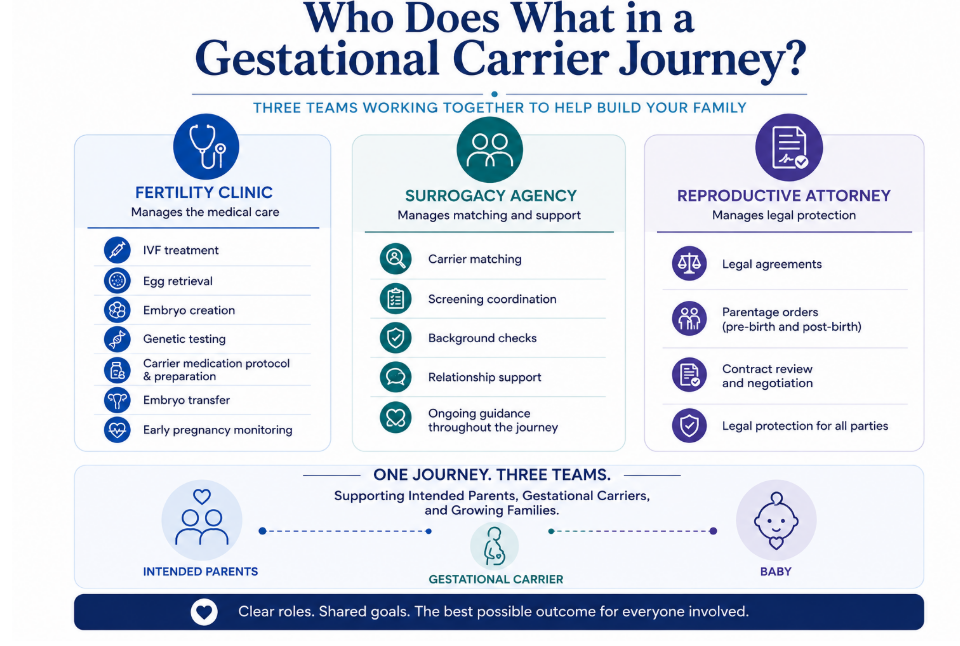
The fertility clinic manages the medical components: the intended mother’s or donor’s egg retrieval and stimulation cycle, fertilization and embryo culture, any preimplantation genetic testing, the carrier’s endometrial preparation protocol, the embryo transfer, and early pregnancy monitoring. When donor eggs are required, the clinic coordinates donor selection and cycle synchronization as well.
The agency manages carrier identification, pre-screening, background checks, profile presentation, match facilitation, and ongoing relationship support throughout the pregnancy. A reproductive attorney manages the legal contract, which must be fully executed before any medical treatment begins. The attorney also obtains the parentage order through the courts, establishing the intended parents’ legal rights before delivery.
These three parties operate in parallel, and delays in any one of them delay the others. Intended parents who begin the agency and legal processes at the same time as the fertility workup move through the timeline most efficiently.
Starting the Gestational Carrier Process at Damien Fertility Partners
Knowing what a gestational carrier is, how to find one, and what the qualification process entails puts intended parents in a much stronger position to start with realistic expectations about both the timeline and the work involved.
Damien Fertility Partners provides gestational carrier IVF across its New Jersey offices in Shrewsbury, Newark, and Jersey City. The same physician follows intended parents from the first consultation through embryo creation and the carrier’s transfer cycle.
The practice serves LGBTQ+ intended parents, including gay male couples and single men who require both a gestational carrier and a donor egg as part of their family building plan. Virtual consultations are available for intended parents who want to begin the medical conversation before committing to an agency or beginning a carrier search.
Frequently Asked Questions
1. Are gestational carriers paid?
Yes. In the United States, gestational carriers receive financial compensation for their role in carrying a pregnancy. First-time carriers typically receive base compensation between $30,000 and $50,000, plus reimbursement for pregnancy-related expenses including maternity clothing, travel to medical appointments, lost wages, and childcare during appointments. Compensation amounts vary by agency, location, and the carrier’s experience.
2. Can a family member be a gestational carrier?
Yes. Using a known carrier, including a sibling, close friend, or other family member, is permitted and practiced. A known carrier must still complete the full medical and psychological qualification process required of any gestational carrier, and a legal agreement must be executed by a reproductive attorney before medical treatment begins. Some intended parents prefer this route for the existing trust it brings; others find the agency matching process introduces useful professional structure.
3. Does the gestational carrier have any rights to the baby?
In New Jersey, under the Gestational Carrier Agreement Act of 2018, a properly executed gestational carrier agreement establishes that the intended parents are the legal parents of the child. The carrier has no parental rights. A parentage order obtained before birth through the New Jersey courts makes this legal standing explicit before delivery occurs. This is one reason working with a reproductive attorney experienced in New Jersey surrogacy law is a required step, not an optional one.
4. How long does it take to find a gestational carrier?
The matching phase through a surrogacy agency typically runs three to nine months depending on the agency and how specific the intended parents’ preferences are. This is usually the longest single phase of the entire process. Intended parents who begin fertility workup and legal consultation at the same time as the agency search, rather than sequentially, reduce the overall timeline meaningfully.
5. What happens if the gestational carrier miscarries?
A miscarriage during a gestational carrier cycle is handled medically by the fertility clinic. The carrier receives medical care, and the intended parents’ remaining embryos, if any, are available for a subsequent transfer after appropriate recovery time. The legal agreement typically addresses the possibility of failed transfers and miscarriage, including the process for attempting additional cycles. This is one of the many contingencies the legal contract phase is designed to anticipate.