
Is the HSG Test Painful? What to Expect During the Procedure

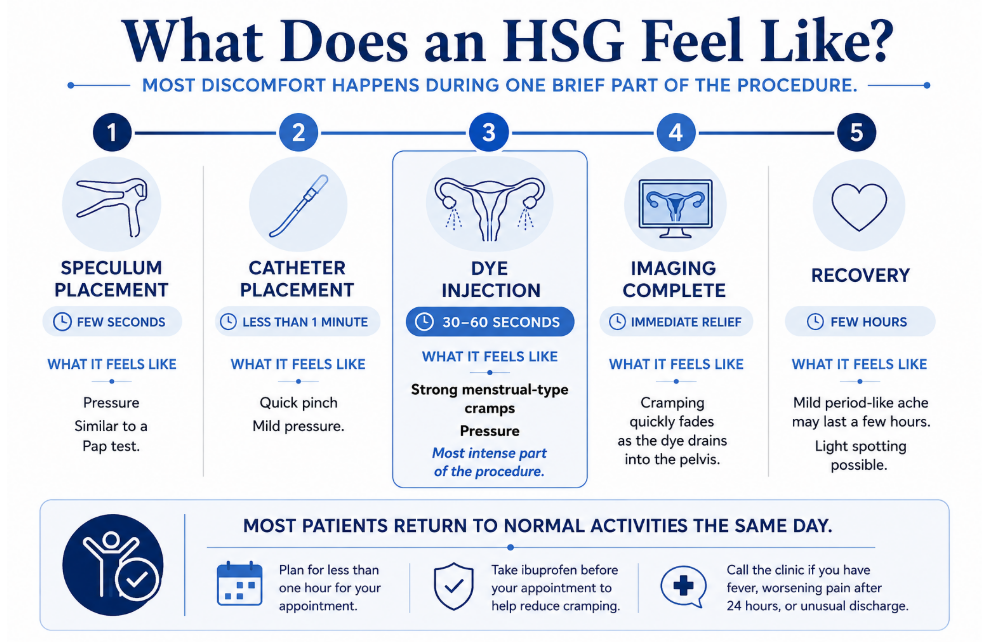
If you are feeling nervous about your HSG test, you are certainly not alone. While most patients do feel some discomfort, it usually feels more like a bout of strong period cramps rather than surgical pain. The good news is that the cramping is very brief; the peak usually lasts just 30 to 60 seconds while the contrast dye is moving into the uterus.
It often helps to know exactly what is happening and when to expect those few moments of pressure. Understanding the process can go a long way in helping you feel more in control and prepared for the appointment.
When you visit Damien Fertility Partners in Shrewsbury, Newark, or Jersey City, our team includes the HSG as a key part of your initial fertility evaluation. If you have a history of endometriosis, prior pelvic surgery, or cervical stenosis, please let us know during your consultation. We want to tailor the procedure to your needs. You can explore how this fits into your overall journey on our fertility evaluation page.
What Most Patients Actually Feel
For the vast majority of people, the experience is manageable. Because there are no incisions or anesthesia involved, you won’t need to plan for a long recovery period. Most of the sensation comes during two specific parts of the imaging.
The first is the catheter passing through the cervix. For most people this registers as pressure or a quick pinch, close to a Pap smear. A narrow cervical opening, sometimes called cervical stenosis, can make this moment sharper than average.
The second part is usually when the sensation is strongest. As the dye fills the uterus, the cavity stretches slightly to accommodate it, which causes that peak cramping. It tends to climb quickly and then fade away within a minute or two as the dye moves into the tubes and the test finishes up.
What Causes the Cramping and When It Peaks
Since the uterus is a muscle, it naturally wants to contract when it is filled or stretched. The dye entering through the catheter triggers a muscular response very similar to what you might feel during a heavy period or an IUD insertion. This involuntary response is actually what causes most of that temporary discomfort.
The peak usually hits within the first 60 seconds of the dye going in and fades as the procedure ends. If both tubes are open, the dye drains into the pelvis fairly quickly and the stretch is brief. If a tube is blocked, the dye backs up against the obstruction and the pressure holds longer.
There is a smaller, separate source of discomfort: the table itself. The imaging requires lying flat with your legs in stirrups for the duration, which is not painful but can wear on anyone with hip or back issues.
How to Prepare and Take the Edge Off
Many patients find that taking 400 to 600 milligrams of ibuprofen about 30 to 60 minutes before the appointment makes a world of difference. Since it acts as both a pain reliever and an anti inflammatory, having it in your system before you arrive ensures it is already working when the cramping peaks.
You might be surprised by how much your breathing can help. It is natural to tense up when you are anxious, but that can tighten the pelvic floor and make cramping feel more intense. Trying to focus on slow, steady exhales while the dye is being injected can help keep your muscles loose and make the procedure much easier to ride out.
If past pelvic exams have been rough for you, or you have been told your cervix is narrow, ask the radiologist whether a smaller catheter or topical cervical numbing is available. Not every radiology suite offers either, but the question costs nothing.
Who Tends to Find It More Uncomfortable
Everyone’s body is different, so pain during an HSG isn’t the same for everyone. A few specific medical histories can sometimes make the process feel a bit more intense.
For example, if you have cervical stenosis (a narrowing of the cervical canal from surgery or anatomy), you might feel a bit more pressure when the catheter is placed. It’s always a good idea to flag this for your doctor ahead of time so the radiology team can be extra mindful.
Endometriosis or pelvic adhesions from earlier surgery can amplify the cramping during the dye phase, since an already inflamed pelvis tends to be more sensitive to pain. The HSG does not make endometriosis worse, but it can make the pain register louder.
Patients who have never been pregnant sometimes have a tighter cervical canal than those who have carried a pregnancy to term, which can make catheter placement a little more uncomfortable. It is not a reason to skip the test, just useful context for what to expect.
What Happens After
The best part is that once the catheter is removed, that sharp cramping usually disappears almost instantly. You might feel a dull ache similar to a period for a few hours while your uterus settles back down, but most people find that the ibuprofen they took earlier handles this just fine.
Some dye drains for several hours afterward, which is normal. Bring a pad, and expect light spotting for a day or two. Most patients go back to work and normal activity the same day.
Fever, pelvic pain that climbs rather than settles after the first 24 hours, or unusual discharge in the days afterward can point to a pelvic infection and warrant a call to the clinic. Pelvic infection is reported in roughly 1.4 to 3.4 percent of HSG procedures, and the American Society for Reproductive Medicine notes that the risk runs highest in patients with a history of tubal disease, such as a prior chlamydia infection. It is uncommon, but it needs prompt attention when it happens.
Why the HSG Is Hard to Skip
While it might be tempting to look for a way around it, the HSG provides a unique view that other tests can’t match. It is the only non-surgical way to see both the inside of your uterine cavity and your fallopian tubes at the same time. This information is vital because it helps us determine which fertility treatments will be most effective for you.
Patients often ask if they can swap this for an ultrasound or surgery. While a saline-infusion ultrasound is great for checking the uterine cavity, it can’t confirm if your tubes are open. On the flip side, laparoscopy can check the tubes but requires anesthesia and recovery time. The HSG strikes a balance between being thorough and minimally invasive.
For patients at Damien Fertility Partners, the result points straight to the next step. Open tubes support ovulation induction with IUI for the right candidates. Blocked tubes move the conversation toward IVF.
Talk Through Your HSG Before the Appointment
We want you to feel comfortable, so please don’t hesitate to voice any concerns or ask about accommodations like smaller catheters. Your physician can include these details in your referral so the radiology team is fully prepared for your visit.
Damien Fertility Partners sees patients in Shrewsbury, Newark, and Jersey City, with virtual consultations available if you would rather talk it through before coming in. Request one through the How to Begin page and the team will help you set the timing around your cycle.
Frequently Asked Questions
How painful is the HSG test on a scale of 1 to 10?
Most patients rate the HSG in the low to middle range, with the peak discomfort lasting only 30 to 60 seconds during the dye injection before it drops off. Taking ibuprofen beforehand and breathing slowly through the procedure tends to bring the number down. A history of cervical stenosis or endometriosis tends to push it up.
How long does the pain last during and after the HSG?
The strongest cramping happens during the dye injection and usually clears within minutes of the procedure ending. An ache resembling a period then lingers for about two to four hours while the uterus returns to its resting state. Most patients feel close to normal by that afternoon.
Does the HSG hurt more if your tubes are blocked?
Generally yes. A blocked tube stops the dye from draining, so it backs up against the obstruction and holds pressure in the uterus and tube longer. Patients with a complete blockage on both sides often feel more sustained discomfort than those whose tubes are open.
Can I take anything stronger than ibuprofen for the HSG?
Ibuprofen is the standard recommendation and handles it for most patients. Some physicians will prescribe a stronger anti-inflammatory or, for patients with known pain sensitivity, a low dose anti anxiety medication taken beforehand. These are worth raising with your Damien Fertility Partners physician before the test is scheduled, especially if pelvic exams have been difficult for you in the past.
Is the HSG more painful than an IUD insertion?
The two work through similar mechanics: the cervix is opened slightly and the uterus is stretched. Most patients who have had both describe them as comparable, with the HSG occasionally a touch sharper because of the volume of dye entering the cavity. If you tolerated an IUD insertion reasonably well, the HSG is usually manageable on the same level.