
The Egg Retrieval Process: What Happens Step by Step

The egg retrieval process is the moment an IVF cycle shifts from preparation to action, and for most patients, it carries the most questions. What exactly happens in that procedure room? How long does it take? Will it hurt? How many eggs are realistic to expect?
This article answers those questions specifically and honestly, based on how the process actually unfolds at a fertility practice with an in-house surgical team and an AI-powered embryology lab. If you are already in a cycle or weighing whether IVF is right for you, the IVF team at Damien Fertility Partners serves patients across three New Jersey locations and offers virtual consultations for patients who want to start that conversation from home.
What Is Egg Retrieval and Where It Fits in an IVF Cycle
Egg retrieval, also called oocyte retrieval or follicular aspiration, is the surgical step in an IVF cycle where mature eggs are removed from the ovaries for fertilization in the lab. It follows the ovarian stimulation phase and precedes fertilization, embryo culture, and transfer.
Understanding where retrieval fits within the full sequence helps patients prepare for the weeks leading up to it, not just the day of the procedure.
Ovarian stimulation runs 8 to 14 days. Injectable gonadotropins prompt the ovaries to develop multiple follicles rather than the single egg the body would naturally release. Monitoring appointments using transvaginal ultrasound and blood estrogen levels track follicle growth across this window, typically requiring clinic visits every two to three days.
Once follicles reach the target size, typically 18 to 20 millimeters in diameter, a trigger injection of hCG or leuprolide acetate is administered to complete egg maturation inside the follicle. This timing is not approximate. The retrieval procedure is scheduled exactly 34 to 36 hours after the trigger, because the eggs must be collected before the body ovulates naturally.
Retrieval follows. After that, retrieved eggs move to the embryology lab for fertilization, culture, and assessment over five to six days before transfer or cryopreservation.
What Happens During the Egg Retrieval Procedure
The retrieval itself takes approximately 20 to 30 minutes. It is performed under IV sedation, meaning patients are in a pain-free, deeply relaxed state throughout. General anesthesia is not typically required.
The procedure is transvaginal. A thin needle, guided by real-time ultrasound imaging, passes through the vaginal wall and into each mature follicle. The fluid inside each follicle, which contains the egg, is aspirated and passed directly to the embryology team in the adjacent lab.
The embryologist examines each fluid sample under a microscope and identifies any eggs present. The number retrieved depends on how many follicles were visible during stimulation monitoring and how many contained a mature egg. In most cycles, between 50 and 80 percent of visible follicles yield a retrievable egg, though this varies by patient age and ovarian response.
Most patients spend one to two hours in recovery before going home the same day. A responsible adult must be present for discharge, as IV sedation affects coordination and judgment for several hours after the procedure.
What the Lab Does the Moment Eggs Are Retrieved
The embryology lab receives eggs within minutes of retrieval, and what happens in those first hours shapes the rest of the cycle.
At Damien Fertility Partners, eggs are placed in an environment monitored by CHLOE, an AI-powered system by Fairtility that continuously tracks embryo development while maintaining stable incubation conditions.
Rather than removing embryos for manual inspection, CHLOE monitors their growth without disrupting the environment. The lab is directed by Frank Barnes, PhD, HCLD, and carries triple accreditation from CAP, FDA, and the New Jersey State Department of Health, all with zero deficiencies across all three locations.
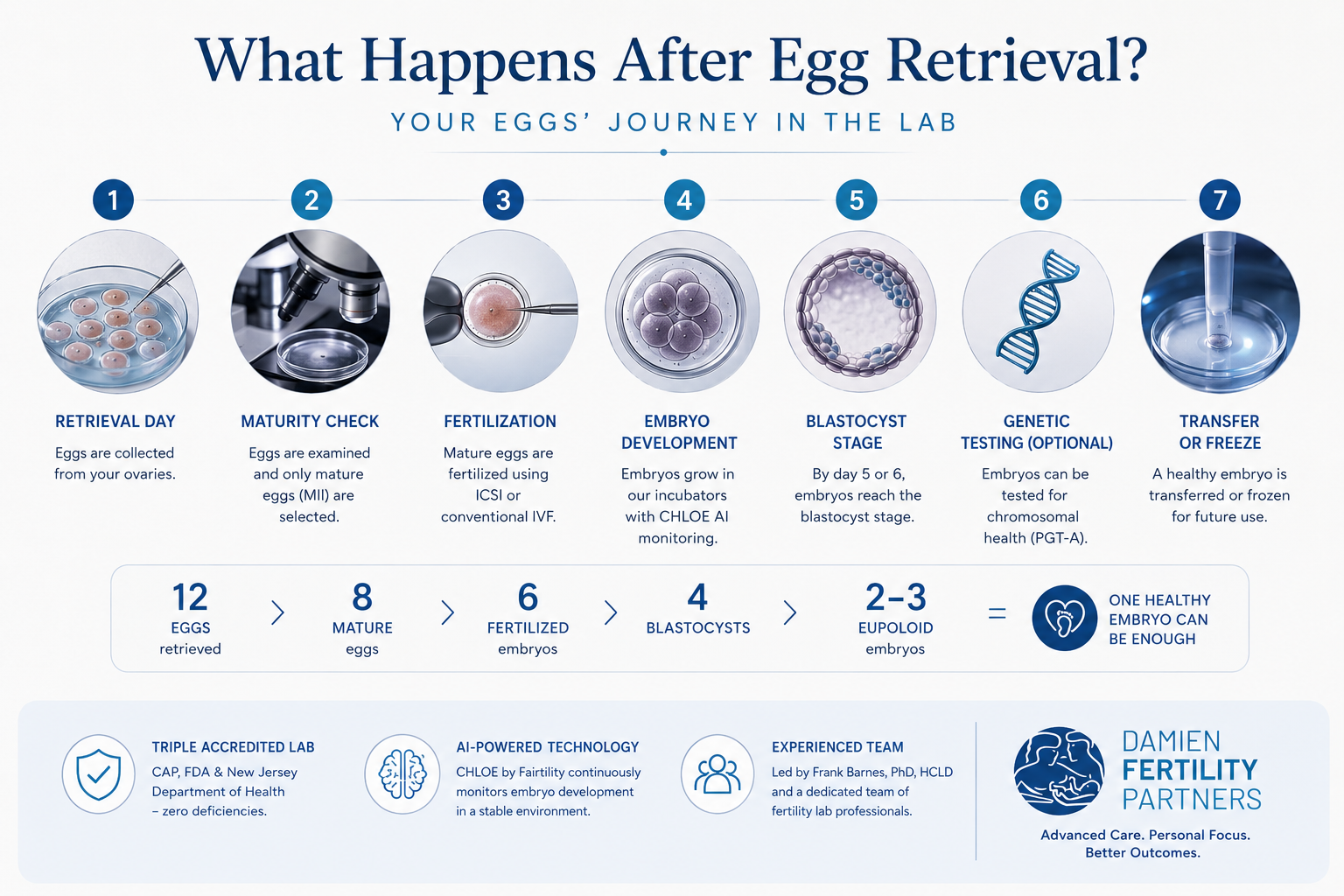
On retrieval day itself, the embryologist first classifies each egg as mature (MII), immature (GV or MI), or degenerate. Only MII eggs are eligible for fertilization. Mature eggs are then fertilized using either conventional insemination or intracytoplasmic sperm injection (ICSI), depending on the protocol established for each patient.
Fertilization is confirmed the following morning by checking for two pronuclei, one from each gamete. From Day 2 onward, embryos are cultured toward the blastocyst stage, typically reached on Day 5 or Day 6. At that point, embryos are either transferred to the uterus or biopsied for preimplantation genetic testing before cryopreservation.
How Many Eggs to Realistically Expect
Egg count is one of the most consistent sources of patient anxiety before retrieval, and the most important thing to understand is that the number retrieved is not the one that matters most.
The number of eggs retrieved per cycle depends on age, ovarian reserve (as measured by antral follicle count and AMH levels), stimulation response, and retrieval technique. According to SART national data, the average IVF cycle in the United States retrieves between 10 and 15 eggs across all age groups. Patients under 35 with normal AMH levels typically see higher numbers; patients over 40 or with diminished ovarian reserve typically see fewer.
Attrition occurs at every stage after retrieval. A representative cycle that starts with 12 retrieved eggs might yield 8 mature eggs, 6 fertilized embryos, 4 blastocysts, and 2 to 3 euploid embryos after genetic testing. That is a clinically sound outcome. Patients who focus on the retrieval number often lose sight of the fact that a single euploid blastocyst is all one successful transfer requires.
Damien Fertility Partners reports success rates consistently above the national average. Full outcomes data is publicly available through the SART database under Clinic ID 2518.
Recovery: What the Days After Retrieval Look Like
Pelvic cramping, bloating, and light spotting in the 24 to 48 hours following retrieval are expected. The ovaries, enlarged during stimulation, take several days to return to their baseline size, and that process accounts for most of the post-procedure discomfort.
Acetaminophen is the standard recommendation for pain management. Nonsteroidal anti-inflammatory drugs like ibuprofen are sometimes restricted depending on the luteal phase protocol, so each patient should confirm with their care team what is appropriate for their specific situation.
A small percentage of patients develop ovarian hyperstimulation syndrome, or OHSS, where the ovaries respond too strongly to stimulation medications. Mild OHSS resolves on its own within one to two weeks. Moderate or severe cases require closer monitoring and, in rare instances, medical management. The monitoring appointments built into the stimulation phase exist in part to identify patients at elevated risk of OHSS early, allowing for protocol adjustments before retrieval.
Most patients who work desk jobs return to work within one to two days. Strenuous exercise, heavy lifting, and intercourse are generally restricted for a full week after retrieval to allow the ovaries to recover.
Why the In-House Surgical Team Matters for Egg Retrieval
Damien Fertility Partners maintains an in-house minimally invasive surgical team, which is not standard across fertility practices. Dr. Nina Seigelstein is a board-certified OB/GYN and gynecologic surgeon who works within the practice and performs procedures at six affiliated facilities, including Riverview Medical Center, Monmouth Medical Center, and Hackensack University Medical Center.
The clinical nursing team, led by Gloria Lopez, NP, works in tandem with the surgeons and embryologists to manage the stimulation protocols and patient education throughout the retrieval process.
For the egg retrieval process specifically, this matters when a patient also has structural conditions such as fibroids, endometriosis, or ovarian cysts. These conditions can complicate access to follicles during retrieval or affect how the ovaries respond to stimulation.
Addressing them surgically before a cycle, with the same care team that manages the IVF protocol, eliminates the coordination gap associated with outside referrals. The patient’s history is known, the approach is coordinated, and no time is lost transferring care between providers.
Ready to Map Out Your Own Retrieval Protocol?
Every patient’s egg retrieval looks different based on ovarian reserve, age, stimulation response, and history.
If you want a clear picture of what your specific cycle would involve, including monitoring visit frequency, stimulation protocol, and what the lab does with your eggs day by day, Damien Fertility Partners offers consultations at its New Jersey locations in Shrewsbury, Newark, and Jersey City, as well as virtual appointments. Care here is never a standard protocol handed to every patient. It is built around you.
Frequently Asked Questions
How painful is egg retrieval?
Egg retrieval is performed under IV sedation, so patients do not feel pain during the procedure itself. Pelvic cramping, bloating, and mild soreness in the 24 to 48 hours afterward are common and typically resolve within two to three days, with intensity comparable to menstrual cramps.
How long does the egg retrieval procedure take?
The procedure itself takes approximately 20 to 30 minutes. Including preparation, sedation, and post-procedure recovery before discharge, patients should plan to spend two to four hours at the clinic on retrieval day.
Can I go to work the day after egg retrieval?
Most patients who work desk jobs return to work one to two days after retrieval. Physical labor, strenuous exercise, and long-distance travel are generally restricted for a week to allow the ovaries to recover from both the stimulation medications and the procedure.
What happens if no mature eggs are retrieved?
A cycle in which no mature eggs are recovered is sometimes called empty follicle syndrome. It is uncommon but does occur, with causes ranging from a mistimed or inadequate trigger shot to poor follicle response or individual biological variation. A fertility specialist will review the cycle in detail and discuss whether a modified protocol in a subsequent attempt is appropriate.
Does egg retrieval reduce my future egg supply?
No. Egg retrieval removes eggs from follicles that have already been recruited and are developing in that specific cycle. The stimulation medications prompt the ovaries to mature eggs that would otherwise have been reabsorbed by the body during the natural menstrual cycle. Published research has not demonstrated that undergoing egg retrieval reduces future ovarian reserve or natural fertility.
How many eggs does the average IVF cycle retrieve?
According to SART national data, the average IVF cycle retrieves between 10 and 15 eggs across all patient ages, with results varying considerably by age and ovarian reserve. Patients under 35 with normal AMH levels typically retrieve more; patients over 40 or with diminished ovarian reserve typically retrieve fewer. The number that matters most is the number of chromosomally normal blastocysts that result, since a single euploid embryo is sufficient for a single transfer attempt.