
Frozen Embryo Transfer: Process, Timeline, and What to Expect

A frozen embryo transfer, or FET, places a previously cryopreserved embryo into the uterus. It is how most IVF cycles end up producing a pregnancy, and for many patients it is the step where months of testing, stimulation, and retrieval pay off. Knowing what each part of the process does, and how long it takes, makes the whole thing easier to get through.
At Damien Fertility Partners, frozen embryo transfers are performed at three New Jersey locations: Shrewsbury, Newark, and Jersey City.
Monitoring visits may be handled by Nurse Practitioners Gloria Lopez or Elizabeth Piercy, both AANP-certified FNPs working within the care team, while the transfer itself is always performed by the physician. The practice reports outcomes through the SART registry under Clinic ID 2518, and full success rate data is available to review before you begin a cycle.
If you have frozen embryos waiting, a consultation is the place to map out what your FET would look like.
What a Frozen Embryo Transfer Is and When It Is Used
In an IVF cycle, embryos that are not transferred right after retrieval are cryopreserved using a technique called vitrification. Vitrification is an ultrarapid freezing process that stops ice crystals from forming inside the embryo’s cells. It produces embryo survival rates above 95% after thaw, a sharp improvement over the slow-freeze methods used before the mid-2000s.
Frozen transfers come into play in a few situations. Patients who undergo preimplantation genetic testing have to freeze their embryos while results come back, since the biopsy and analysis take 7 to 14 days.
Patients at elevated risk for ovarian hyperstimulation syndrome do better with a freeze-all approach, which lets the ovaries recover before any transfer. And patients building up several euploid embryos transfer them later, after stacking a frozen cohort over consecutive retrieval cycles.
The fertility preservation page specifically covers vitrification for egg freezing. Embryo cryopreservation uses the same technology.
The Two Protocol Types: Natural Cycle vs. Medicated Cycle
Before a frozen embryo is placed, the uterine lining must be prepared to receive it. There are two ways to do that, and the right one depends on whether you ovulate regularly on your own.
In a natural cycle FET, your own hormones drive the preparation of the lining. The cycle is tracked with ultrasound and blood work to follow follicle development and the LH surge that triggers ovulation.
Once ovulation is confirmed, progesterone production begins, and the transfer is timed to that event. This route skips the extra medications but requires predictable ovulatory cycles and close monitoring to catch the surge at the right moment.
In a medicated, or programmed, cycle, ovarian activity is suppressed and the lining is built entirely with hormones you take. Estrogen is usually started first, as oral tablets or a patch, over two to three weeks to develop the lining.
After the lining reaches the right thickness and pattern, progesterone is added, and the transfer date is counted from there. Medicated cycles give more scheduling control and are the standard for patients with irregular cycles, anyone who has had trouble with natural cycle monitoring, and cycles being coordinated around PGT results.
The FET Timeline, Week by Week
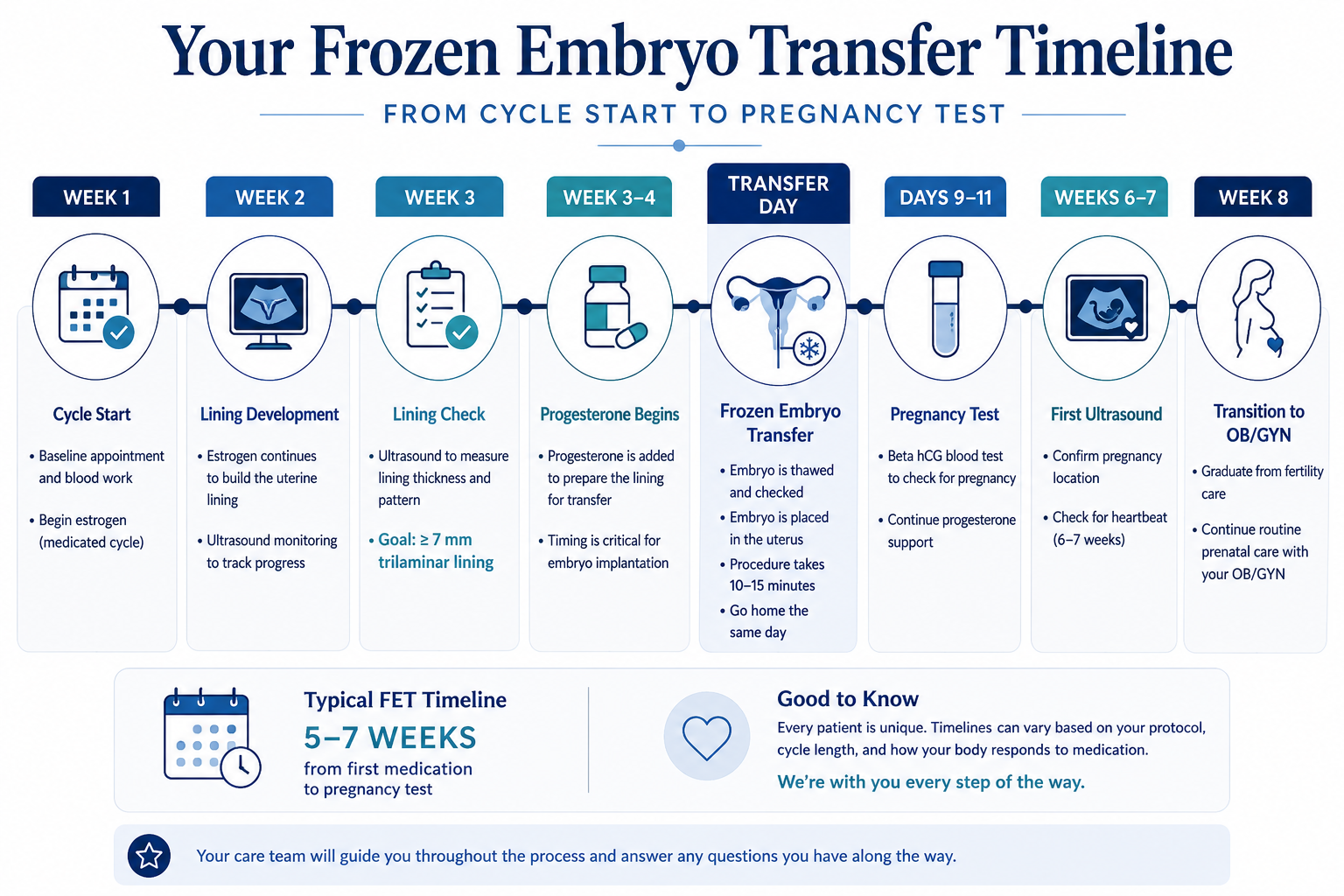
The preparation phase runs roughly three to five weeks from the first medication to transfer day, depending on the protocol.
In a medicated cycle, estrogen usually starts between Days 1 and 3 of the menstrual cycle. A monitoring ultrasound happens around Day 10 to 12 to check lining thickness and pattern. A trilaminar lining measuring at least 7mm on ultrasound is the standard benchmark before an FET proceeds. Most patients hit it on the first check; some need another week of estrogen and a second visit.
Once the lining is confirmed, progesterone begins. For a Day 5 blastocyst, progesterone runs for 5 to 6 days before transfer, matching the luteal phase timing the embryo would see in a natural cycle. The timing is exact. Starting progesterone a day early or late shifts the synchrony between embryo and lining and can affect whether implantation takes place.
Transfer day is set by the day progesterone started, not by the calendar. From cycle start to transfer is typically 3 to 5 weeks. Add the two-week wait afterward, and the full cycle runs about 5 to 7 weeks from the first medication to the first pregnancy test.
What Happens on Transfer Day
The transfer takes about 10 to 15 minutes and needs no anesthesia. You will be asked to arrive with a comfortably full bladder, which helps the physician see the uterus clearly on the abdominal ultrasound used to guide the catheter.
The embryo is thawed in the lab that morning. The embryologist confirms it survived and, in most cases, watches a short re-expansion period to verify it is recovering normally before loading it into the catheter.
The physician passes a thin, flexible catheter through the cervix into the uterine cavity under ultrasound guidance, then releases the embryo at a set spot in the upper cavity. Most people describe the sensation as close to a Pap smear. Mild cramping is common.
You leave within an hour and can go back to normal, low-intensity activity the same day. Bed rest is not required, and current evidence does not show it improves outcomes.
Physician-Specific Transfer Protocols
Embryo transfers are performed exclusively at the Shrewsbury location. While general preparations are similar, specific requirements depend on your physician’s preferred technique:
- Dr. Damien does not require a full bladder for transfers. He pre-measures the uterus to determine precise embryo placement rather than relying on active ultrasound guidance.
- Dr. Perlman requires patients to arrive with a full bladder, as he utilizes abdominal ultrasound guidance to visualize the uterine cavity during the transfer procedure.
After the Transfer: The Two-Week Wait and What Follows
The 9 to 11 days between transfer and the first beta hCG blood test tend to be the hardest part of the cycle emotionally. Progesterone support continues throughout, regardless of symptoms. Progesterone itself can produce early pregnancy symptoms like breast tenderness and fatigue, which makes reading into symptoms unreliable in either direction.
The first blood test measures beta-hCG, the hormone produced by the implanting embryo. A positive result gets a repeat test 48 hours later to confirm the level is climbing the way it should. In early pregnancy, hCG that doubles every 48 to 72 hours is the expected pattern; a slower rise prompts closer monitoring.
The first ultrasound usually happens at 6 to 7 weeks to confirm a heartbeat. At Damien Fertility Partners, care continues through about 8 weeks before the handoff to your OB/GYN, as described in the fertility care and OB/GYN collaboration overview on the blog. The fertility team stays available for questions the entire time.
FET Success Rates: What the Numbers Actually Show
Frozen embryo transfer success rates depend on the egg’s age at retrieval, the embryo’s chromosomal status, and the lining’s response.
For patients transferring a euploid embryo, meaning chromosomally normal with 46 chromosomes in 23 pairs, published PGT cohort and SART national data show per-transfer live birth rates of 60 to 70% in patients under 38. Those numbers reflect the embryo selection made possible by preimplantation genetic testing.
For untested embryos, rates run lower and drop off faster with age, because older age groups carry a higher proportion of chromosomally abnormal embryos. One point patients often miss: the age that matters for embryo quality is the age at retrieval, not the age at transfer. An embryo created at 32 carries the chromosomal profile of a 32-year-old egg no matter when it is transferred.
Damien Fertility Partners reports full-cycle outcomes via the SART database under Clinic ID 2518. Going through those numbers with your physician gives you the most accurate read on what is realistic for your situation.
Preparing for Your FET at Damien Fertility Partners
FET preparation and timing look different for every patient, shaped by cycle history, protocol type, and whether genetic testing results are part of the plan.
Damien Fertility Partners runs FET cycles across its New Jersey offices in Shrewsbury, Newark, and Jersey City. One physician follows each patient through the transfer and the early weeks of a confirmed pregnancy, with monitoring visits supported by the nursing team. If you have frozen embryos here or at another clinic and want to know what a transfer would involve, the team can walk through your cycle history and the protocol that fits it. Virtual consultations are available if you would rather start that conversation before coming in.
Frequently Asked Questions
How long does a frozen embryo transfer cycle take?
A medicated FET cycle runs about 3 to 5 weeks from the start of estrogen to transfer day. Add the two-week wait afterward, and most patients reach their first pregnancy test within 5 to 7 weeks of starting. Natural cycle timelines depend on your own cycle length.
Does a frozen embryo transfer hurt?
The transfer is usually described as mild discomfort, similar to a Pap smear. A thin catheter passes through the cervix into the uterine cavity, which can cause brief cramping. There is no anesthesia, the procedure takes about 10 to 15 minutes, and most patients leave within an hour.
Is a frozen embryo transfer more successful than a fresh transfer?
For most patients, frozen transfers now match or exceed fresh transfers because the lining is not exposed to the high estrogen levels produced by ovarian stimulation. When embryos have also undergone preimplantation genetic testing, frozen transfers offer the added advantage of confirmed chromosomal status going in.
How many monitoring appointments does a FET cycle require?
A medicated FET cycle usually involves 2 to 3 monitoring visits before transfer: a baseline check, a lining check around Day 10 to 12 of estrogen, and sometimes a second lining check if the first comes up short. The transfer is the final in-clinic visit before the pregnancy test.
What is the endometrial lining thickness required for FET?
The standard benchmark is a trilaminar pattern measuring at least 7mm on ultrasound before progesterone starts and a transfer date is set. Patients who fall short on the first check may stay on estrogen another week before a follow-up. Transfers are not scheduled until the lining clears both the thickness and pattern criteria.
Can I do a frozen embryo transfer with embryos frozen years ago?
Yes. Vitrified embryos do not degrade meaningfully over time when stored correctly, and published case reports include successful transfers from embryos stored more than 10 years. What matters is embryo quality at the time of freezing, not how long it has been in storage. Your physician will review the original grading and any genetic testing results when planning the protocol.