
Gestational Carrier: How It Works and Who It’s For

Gestational carrier is an arrangement in which a woman carries and delivers a baby for intended parents, using an embryo she has no genetic link to. The embryo is created through IVF using eggs and sperm from the intended parents or chosen donors, then transferred to the gestational carrier’s uterus. She is not the biological mother of the child she carries.
At Damien Fertility Partners, gestational carrier is offered across three New Jersey locations in Shrewsbury, Newark, and Jersey City.
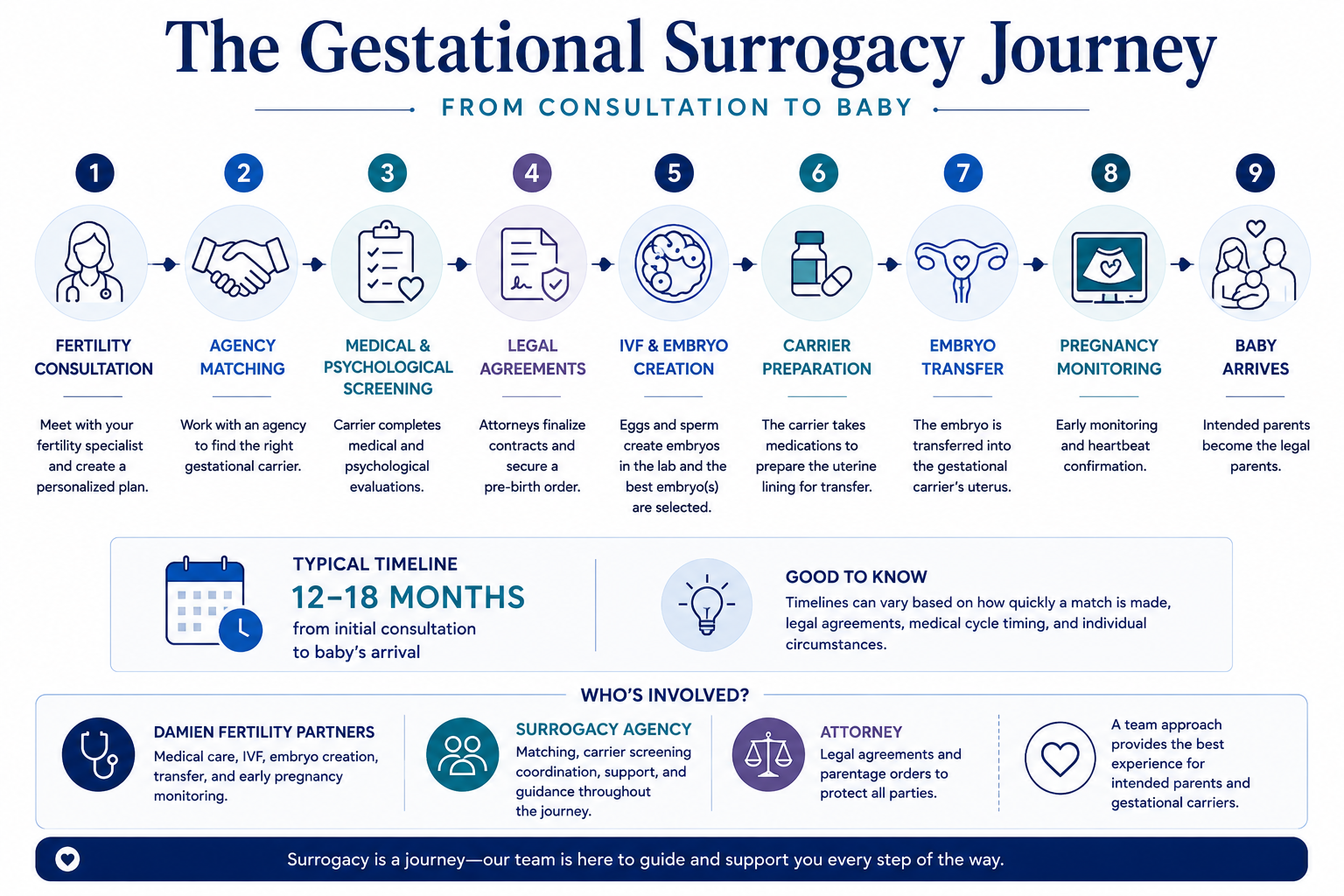
The practice handles the medical side of the process, from embryo creation through transfer and early pregnancy monitoring, while surrogacy agencies and mental health professionals manage matching and support.
If you are trying to work out whether this path fits your situation, the gestational carrier program page lays out what the practice manages medically and where outside coordination comes in.
Gestational Carrier vs. Traditional Surrogacy: Why the Distinction Matters
In a gestational carrier arrangement, the woman carrying the pregnancy contributes no genetic material. The embryo transferred to her uterus comes entirely from the intended parents or from donor eggs and sperm. She is called a gestational carrier.
Traditional surrogacy uses the carrier’s own egg, which makes her the biological mother of the child. That creates serious legal and ethical complications around parental rights, and it is not practiced in New Jersey. When most people say “surrogacy” today, they mean a gestational carrier arrangement.
The difference is not academic. It decides which legal framework governs the arrangement and who holds parental rights. New Jersey’s Gestational Carrier Agreement Act, enacted in 2018, directly governs these arrangements and allows intended parents to secure a pre-birth order establishing their legal parenthood before the baby arrives. That statute makes New Jersey one of the friendlier states in the country for carrier arrangements.
Who the Gestational Carrier Path Is For
The gestational carrier path fits intended parents who want a genetic connection to their child when pregnancy is not safe or possible for the person who would otherwise carry it.
The common medical reasons include absence of the uterus, whether congenital or after a hysterectomy, and uterine abnormalities that prevent implantation or carrying a pregnancy to term. It also applies when a serious heart, kidney, or autoimmune condition makes pregnancy a real health risk to the intended mother, or after recurrent pregnancy loss tied to uterine factors when other treatments have run their course.
A gestational carrier is also the route to a genetically related child for gay male couples and single men, since any pregnancy requires a carrier. In those cases, donor eggs are paired with the intended father’s sperm, combining gestational carrier with donor egg IVF.
Age plays a role too. Intended mothers of advanced reproductive age can use a gestational carrier with donor eggs when their own eggs are no longer viable, separating the egg source, the carrier, and the intended parent within one coordinated cycle.
How the Medical Process Works
The medical process follows the same structure as a standard IVF cycle, with the embryo transfer happening in the carrier rather than the intended mother.
If the intended mother provides eggs, she goes through ovarian stimulation, monitoring, and egg retrieval exactly as she would in a standard cycle. Her eggs are fertilized in the lab with sperm from the intended father or a donor. The resulting embryos are grown to the blastocyst stage, and preimplantation genetic testing is often used to identify chromosomally normal embryos before transfer.
When the intended mother’s eggs are not used, the cycle proceeds with donor eggs. The practice works with egg bank partnerships for frozen donor eggs and offers fresh donor cycles when indicated.
Once a euploid embryo is ready, the carrier goes through endometrial preparation identical to a frozen embryo transfer protocol, with estrogen to build the uterine lining and progesterone to time the transfer precisely. The transfer itself is a short office procedure that needs no anesthesia. Early pregnancy monitoring continues with the practice through roughly eight weeks before the carrier transitions to her own OB/GYN.
What the Gestational Carrier Goes Through
The carrier’s role starts well before the transfer. She completes a substantial medical and psychological evaluation before any embryo is placed.
The medical workup includes a uterine cavity assessment to confirm her uterus can support a healthy pregnancy, FDA-required infectious disease screening, a full health history review, and confirmation of prior successful pregnancies, which most agencies require. A psychological evaluation with a licensed mental health professional is also part of the process, both to confirm readiness and to set clear expectations for the arrangement.
This screening serves everyone. Intended parents move toward the transfer knowing that the carrier’s uterine environment and health have been formally assessed, and that the carrier enters the arrangement with professional support already in place.
The Agency, Legal, and Timeline Reality
The fertility clinic runs the medical component. The agency provides matching, carrier screening coordination, legal contract facilitation, and relationship support throughout pregnancy.
Intended parents work with an agency to find a carrier whose profile, values, and expectations line up with their own. Matching is usually the longest phase.
From the start of agency matching through embryo transfer, the process typically takes 12 to 18 months, with wide variation depending on how quickly a match comes together and how smoothly the medical and legal steps proceed. Intended parents who already have frozen embryos ready can shorten that timeline once a carrier is cleared.
The legal agreement between intended parents and the carrier must be signed before any medical treatment begins. In New Jersey, the Gestational Carrier Agreement Act provides that contract with a clear statutory footing and allows intended parents to obtain a pre-birth order through the courts, establishing parental rights before delivery. A reproductive attorney experienced in New Jersey surrogacy law should handle this step.
Gestational Carrier for LGBTQ+ Intended Parents
Gestational carrier is the standard path to a genetically related child for gay male couples and single men. At Damien Fertility Partners, it runs alongside the practice’s broader LGBTQ+ family-building services, which include semen analysis, donor egg selection guidance, and partnerships with mental health professionals experienced in carrier arrangements.
For gay male couples, one or both partners may contribute sperm. Embryos can be created from each partner in separate cycles or from one partner per cycle, depending on the family’s goals. Donor eggs come through the practice’s egg bank partnerships or a fresh donor cycle.
The practice’s commitment to inclusive care extends to LGBTQ+ patients, with no BMI-based care restrictions and bilingual services throughout.
Starting the Gestational Carrier Process at Damien Fertility Partners
Gestational carrier carries more moving parts than most fertility treatments: agency matching, legal contracting, carrier screening, embryo creation, and transfer. Knowing which steps the clinic handles and which are handled by outside partners is where most intended parents start.
Damien Fertility Partners manages the medical components of gestational carrier across its New Jersey offices in Shrewsbury, Newark, and Jersey City. One physician oversees the full IVF cycle, from the initial consultation through embryo creation, the carrier’s transfer cycle, and early pregnancy monitoring.
Monitoring visits during the cycle may be carried out by Nurse Practitioners Gloria Lopez or Elizabeth Piercy, both AANP-certified Family Nurse Practitioners working within the care team, while the procedural appointments, egg retrieval and embryo transfer, are always performed by the physician.
If you are weighing the gestational carrier path and want to understand the medical side before choosing an agency, the How to Begin page covers what a first consultation involves. Virtual visits are available, so you can map out the clinical steps from home before a carrier search begins.
Frequently Asked Questions
What is the difference between a gestational carrier and a surrogate?
A gestational carrier has no genetic connection to the baby she carries. The embryo comes from the intended parents or from donors. A traditional surrogate uses her own egg and is the biological mother of the child, an arrangement largely avoided today because of its legal and ethical complexity. When most people say “surrogate” now, they are describing a gestational carrier.
How long does the gestational carrier process take?
From the start of agency matching through embryo transfer, the process usually takes 12 to 18 months. Matching is typically the longest variable. Once a carrier is identified, medical screening and legal contracting add several months to the transfer cycle. Intended parents who already have frozen embryos ready can shorten the overall timeline once a carrier is matched and cleared.
Are gestational carrier arrangements legal in New Jersey?
Yes. New Jersey enacted the Gestational Carrier Agreement Act in 2018, creating a clear legal framework for carrier arrangements. Intended parents can obtain a pre-birth order establishing their parental rights before the baby is born. Working with a reproductive attorney experienced in New Jersey surrogacy law is recommended to complete the contract before any medical treatment starts.
Who provides the eggs in gestational carrier?
Eggs can come from the intended mother if her ovarian reserve and age make retrieval feasible, or from an egg donor if her eggs are not being used. For gay male couples and single men, a donor egg is always required. Damien Fertility Partners offers frozen donor eggs through egg bank partnerships and fresh donor egg cycles depending on the clinical situation.
Does the gestational carrier need to be medically screened?
Yes. Before any transfer, the carrier completes a uterine cavity assessment, FDA-required infectious disease screening, a full health history review, and a psychological evaluation. Most agencies also require confirmation of prior successful pregnancies as part of their own qualification process.
Can a single person use a gestational carrier?
Yes. The gestational carrier path is available to single intended parents at Damien Fertility Partners. Single men need both a gestational carrier and a donor egg. Single women may use their own eggs if ovarian reserve permits, or donor eggs with a carrier if they cannot safely carry a pregnancy. The services for singles page covers the practice’s broader single-parent options.