
Ovulation Induction: How It Works and When It’s Recommended

Ovulation induction uses fertility medication to prompt the ovaries to develop and release one or more mature eggs. For women who ovulate irregularly or not at all, it restores the one event conception depends on. For women who already ovulate, a lighter version of the same approach sharpens the timing and adds an egg or two to the cycle when paired with intrauterine insemination.
At Damien Fertility Partners, ovulation induction runs as a standalone treatment and as the first phase of IUI and IVF across three New Jersey offices in Shrewsbury, Newark, and Jersey City. Every cycle is tracked with serial ultrasounds and blood draws so the dose can be adjusted and the trigger injection timed to the hour.
If irregular cycles or anovulation are part of your picture, the evaluation and diagnosis page walks through the workup that comes first, and you can book directly from the How to Begin page. One physician oversees that workup and stays with you through every decision that follows, which is the part most patients say they were not expecting after experiences at larger clinics.
What Ovulation Induction Actually Does
In a natural cycle, the pituitary gland releases follicle-stimulating hormone, or FSH, which tells one follicle in the ovary to mature and release an egg. When that signal is missing or erratic, ovulation either cannot happen or happens too unpredictably to plan around.
Ovulation-induction supplements or replace that signal. The medication raises FSH levels that reach the ovaries and drives follicle development that would not occur on its own, or would occur too inconsistently to time.
Most cycles aim for a single mature follicle, occasionally two. That is the line between ovulation induction and the stimulation used in IVF, where the goal is as many follicles as the ovaries will safely produce. For ovulatory dysfunction or IUI, the target is controlled and modest, not maximum yield.
Who Ovulation Induction Is Recommended For
The clearest candidates are women with anovulation, meaning cycles in which ovulation does not happen. The most common cause is polycystic ovary syndrome, which scrambles the hormonal signaling that matures a follicle. Hypothalamic dysfunction, thyroid disorders, and elevated prolactin produce anovulatory cycles that also respond to treatment.
Women who do ovulate can still be candidates when the diagnosis is unexplained infertility, mild male factor, or a cervical factor, with induction paired with IUI. Here the medication is not restoring a missing ovulation. It adds an egg to the cycle and tightens the timing, which raises the odds that sperm and egg meet.
A full evaluation and diagnosis, including hormonal bloodwork, an ovarian reserve check, and a hysterosalpingogram to confirm the fallopian tubes are open, comes before any induction cycle. Starting treatment before the tubes are confirmed open risks running a cycle that was never going to work.
The Medications: Oral Agents and Injectables
Two categories of medication do this work, through different mechanisms, with different monitoring needs and different risk levels.
Letrozole is an aromatase inhibitor. It briefly lowers estrogen, which pushes the pituitary to release more FSH and grow a follicle. It is taken orally for five days early in the cycle, usually Days 3 through 7.
Letrozole has largely replaced clomiphene as the first-choice treatment for PCOS-related anovulation, based on trial data showing higher live-birth rates and fewer side effects. With a single egg as the target, it carries roughly a 5-8% twin rate.
Clomiphene citrate is a selective estrogen receptor modulator. It blocks estrogen receptors in the hypothalamus, the body reads that as low estrogen, and FSH output rises in response. It was the standard for decades and is still used, though letrozole now leads for most anovulatory patients.
Injectable gonadotropins contain FSH, LH, or both, and stimulate the ovaries more directly and more strongly. They come in when oral agents have failed, when the goal is two or three follicles for an IUI cycle, or as part of IVF stimulation. Injectable cycles need closer monitoring because the response is harder to predict, and the risk of too many follicles, multiple pregnancy, or ovarian hyperstimulation syndrome runs higher than with pills.
What Monitoring Looks Like During a Cycle
Induction cycles are monitored from start to finish. The monitoring is what keeps them both safe and effective, and knowing the rhythm helps you plan around the visits.
A baseline ultrasound is performed at the start, usually on Day 2 or 3, to confirm that the ovaries are quiet before medication begins. This rules out a residual cyst from the prior cycle that could skew the response.
A second ultrasound is performed during stimulation, often around Day 10 to 12 in an oral cycle, to measure follicle growth, with an estradiol blood level drawn the same day to confirm that the follicle is producing hormones as expected. A follicle of 18 to 20 millimeters is the standard cue to trigger.
The trigger injection, usually hCG or leuprolide acetate, is given once the follicle reaches target size. It completes egg maturation and triggers ovulation about 36 to 40 hours later. For an IUI cycle, the insemination is timed 24 to 36 hours after the trigger to land in the ovulation window.
At Damien Fertility Partners, monitoring visits may be conducted by Nurse Practitioners Gloria Lopez or Elizabeth Piercy, both AANP-certified family nurse practitioners on the care team, while one physician oversees the full cycle and performs any procedural appointments.
Ovulation Induction With IUI vs. IVF: How They Connect
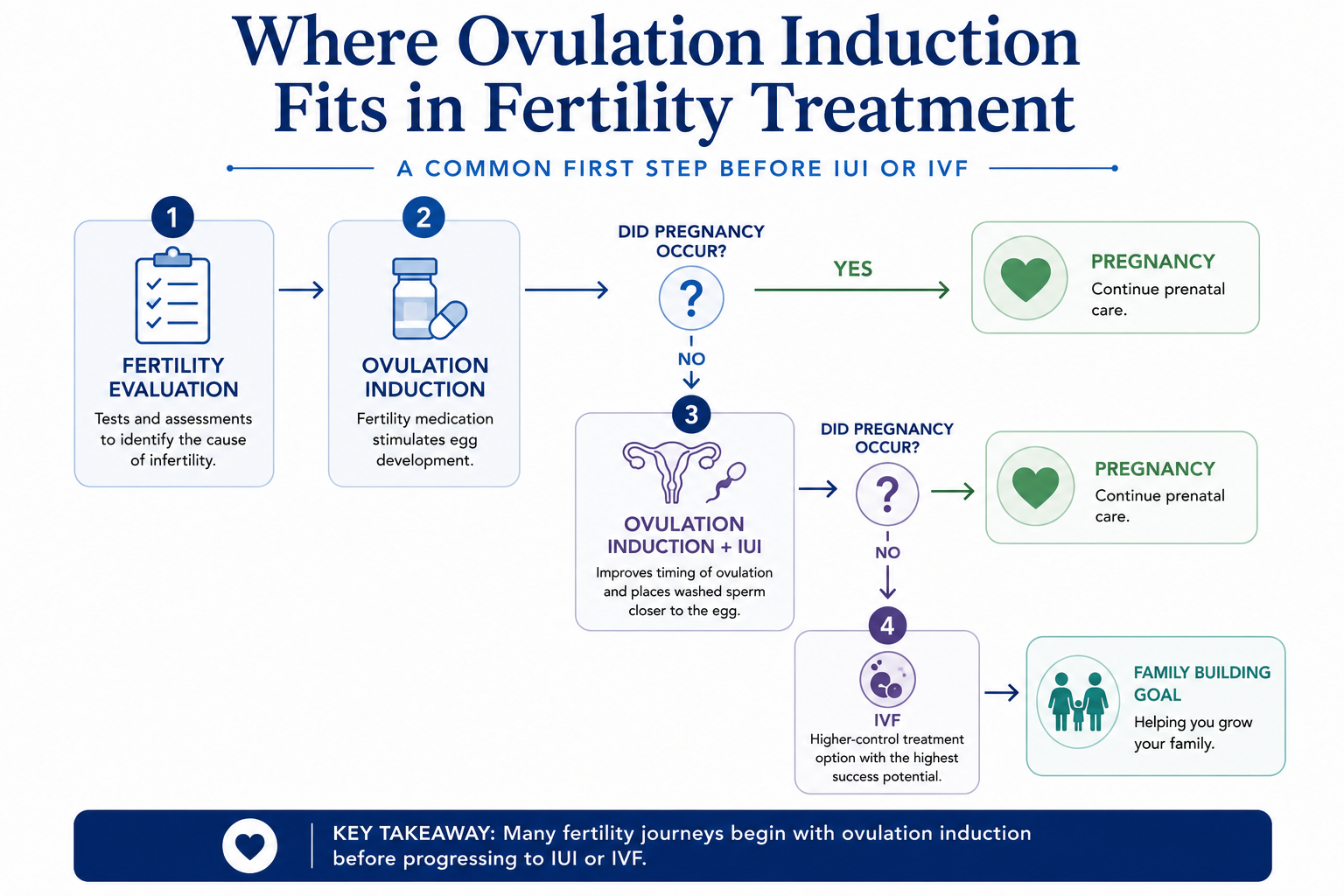
Induction almost always sets up a second step. On its own, it only improves the quality and timing of the egg released into the tube. Sperm and egg still have to meet, by natural conception or an assisted method.
Paired with IUI, induction improves the timing of the egg and places washed sperm at the top of the uterine cavity. That combination handles two of the most common barriers to natural conception at once, and it is the standard first-line plan for most ovulatory dysfunction and unexplained infertility.
Paired with IVF, induction becomes controlled ovarian stimulation. The goal shifts from releasing one or two eggs naturally to retrieving a batch for fertilization in the lab. Same medication families, higher doses, tighter monitoring, and the endpoint is egg retrieval rather than insemination or timed intercourse.
When to Move Beyond Ovulation Induction
Induction with IUI is a strong opening move, not an endlessly repeatable one. Cumulative success rates flatten after a handful of cycles, and past that point you are spending time and money for shrinking returns.
Most reproductive endocrinologists reassess after three to six failed induction-plus-IUI cycles, sooner for patients over 35. IVF pinpoints where fertilization fails, allows genetic testing of embryos, and produces higher per-cycle success than IUI for most profiles above a certain age or after repeated IUI failures.
Reaching that point does not mean induction failed. Different parts of conception can break independently, and IVF reaches factors that induction with IUI simply cannot.
Starting Ovulation Induction at Damien Fertility Partners
Induction is often the first step for ovulatory dysfunction, but how long to stay with it should follow a clear read of the underlying cause, not a habit of reaching for the simplest option. Damien Fertility Partners, a privately owned practice operating in New Jersey since 1989, runs induction cycles across its Shrewsbury, Newark, and Jersey City offices.
If irregular cycles or a stretch of unsuccessful attempts brought you here, book a consultation through the How to Begin page. Virtual consultations are available for patients who want to talk it through before coming in.
Frequently Asked Questions
What is the success rate of ovulation induction?
Success depends on the cause of infertility, the patient’s age, and whether IUI is added. For women with PCOS using letrozole, pregnancy rates per cycle with timed intercourse run roughly 15 to 25 percent. Add IUI, and cumulative rates across three to four cycles reach 30 to 40 percent in suitable candidates. Rates drop with age and with sperm or tubal problems.
How many cycles should I try before IVF?
Most reproductive endocrinologists reassess after three to six cycles of induction with IUI, depending on age, diagnosis, and whether earlier cycles produced follicles of adequate size. Patients over 35 are usually moved to IVF sooner given the age-related decline in egg quality. There is no universal number, and the call depends on the full clinical picture.
Does ovulation induction increase the chance of twins?
Yes, modestly. Letrozole carries about a 5 to 8 percent twin rate, higher than the natural 1 to 2 percent but well below older protocols. Injectable cycles carry a higher risk of multiples, especially when several large follicles develop together. Monitoring exists partly to catch that and, if needed, cancel a cycle before the trigger.
Can I do ovulation induction if I already ovulate?
Yes. Women who ovulate regularly can still benefit from induction with IUI when the aim is sharper timing or one extra follicle in the cycle. This is common in unexplained infertility and mild male factor cases, where each piece of fertility looks normal, but conception has not happened on its own.
What tests are needed before starting?
A baseline hormonal panel covering FSH, estradiol, AMH, and thyroid function, a hysterosalpingogram to confirm open fallopian tubes, and a semen analysis for the partner are standard. These confirm that induction makes sense, that the tubes can be used, and that sperm quality is worth the cycle. Skipping the workup only delays finding the problems that would change the plan.