
HSG Test in Jersey City, NJ | Damien Fertility Partners

How the Results Change the Plan
An HSG test, or hysterosalpingogram, is an X-ray that shows whether your fallopian tubes are open and whether the inside of your uterus is shaped the way it should be.
Most women hear about it after several months of trying to conceive with nothing to show for it, when a doctor wants to rule out a physical reason. For patients in Hudson County and across the New York metro area, Damien Fertility Partners in Jersey City handles referrals and reads images as part of a full fertility workup.
The Jersey City office sits at One Journal Square Plaza, Suite 301-A, on the corner of JFK Boulevard and Cottage Street, directly off the Journal Square PATH station. It runs the same diagnostic and fertility services as the rest of the practice, including the HSG, hormonal bloodwork, ovarian reserve testing, and semen analysis, Monday through Friday from 7:00 am to 5:00 pm.
If you have been trying for a while and want to know whether an HSG is right for your case, start with a diagnostic evaluation. A physician reviews your history first and orders only the tests your situation calls for, rather than running everything by default.
What an HSG Test Actually Checks
The name comes from the parts it examines: the uterus, the fallopian tubes, and the space between them. A radiologist threads contrast dye into the uterus and watches on live X-ray as it moves up and out through the tubes. Where the dye goes tells the story. Where it stops tells a different one.
It answers two questions you can’t answer any other way short of surgery. Is the inside of the uterus a clean, normal space, or is a fibroid, polyp, or septum crowding the spot where an embryo would implant? And are both tubes open, so an egg and sperm can actually meet?
The test is scheduled between Days 6 and 13 of your cycle, after bleeding stops but before you ovulate. That window keeps the procedure from ever overlapping with a released egg or an early pregnancy.
What It Finds, and What It Misses
An HSG reads structure. It gives a sharp picture of the uterine cavity and the tubes, and it says nothing about the hormonal side of fertility.
On the structural side, it can spot submucosal fibroids and polyps pushing into the cavity, catch a septum splitting the uterus in two, and show whether each tube lets fluid pass. It also flags a hydrosalpinx, a tube that has swelled with trapped fluid, which has to be dealt with on its own before treatment starts.
What it can’t tell you is just as important. It says nothing about your egg supply, egg quality, whether you ovulate normally, or your partner’s sperm. A clean HSG is a good sign, not a clean bill of health, and it’s one piece of the broader evaluation that comes before any treatment plan. The American Society for Reproductive Medicine frames it the same way, as a check on tubal openness and uterine shape rather than a full fertility screen.
One thing surprises most patients: the test itself can nudge the odds in your favor. Studies have found that 10 to 15% of women conceive within three cycles of an HSG, higher than you’d expect over that same stretch without it.
The bump shows up most clearly with oil-based contrast, and the working theory is simple plumbing: the dye flushes out minor debris in the tubes that was slowing sperm down.
What the Day Itself Looks Like
The HSG is performed at a radiology facility, not the clinic, and takes about 15 to 30 minutes. Damien Fertility Partners orders it, then sits down with you afterward to review the images.
You’re positioned the way you would be for a Pap smear. A speculum goes in, then a thin catheter through the cervix into the uterus. Dye flows through the catheter while a fluoroscope films the uterus and tubes filling up in real time.
Dye that runs cleanly through both tubes and spills out the ends means they’re open. Dye that hits a wall and stops marks a blockage, and shows exactly where in the tube it sits.
Cramping is the part people remember, strongest while the dye goes in and works through the tubes. For most women, it lands somewhere around a bad period cramp. It usually eases within two to three hours, and most patients drive themselves home and carry on with their day.
Getting Ready and the Hours After
There isn’t much to do beforehand. A 400 to 600 milligram dose of ibuprofen about 30 to 60 minutes ahead takes a real bite out of the cramping. If you’ve had pelvic inflammatory disease, your physician may add a short course of antibiotics first, just to keep the already-low infection risk lower.
Afterward, leftover dye drains for a few hours, so bring a pad. A day or two of light spotting is normal. Most women are back to normal the same day.
Call the clinic if you spike a fever, the pain sharpens past the first day, or you notice an unusual discharge over the following days. Infection after an HSG is rare, but those are the signs that warrant a look.
How the Results Change the Plan
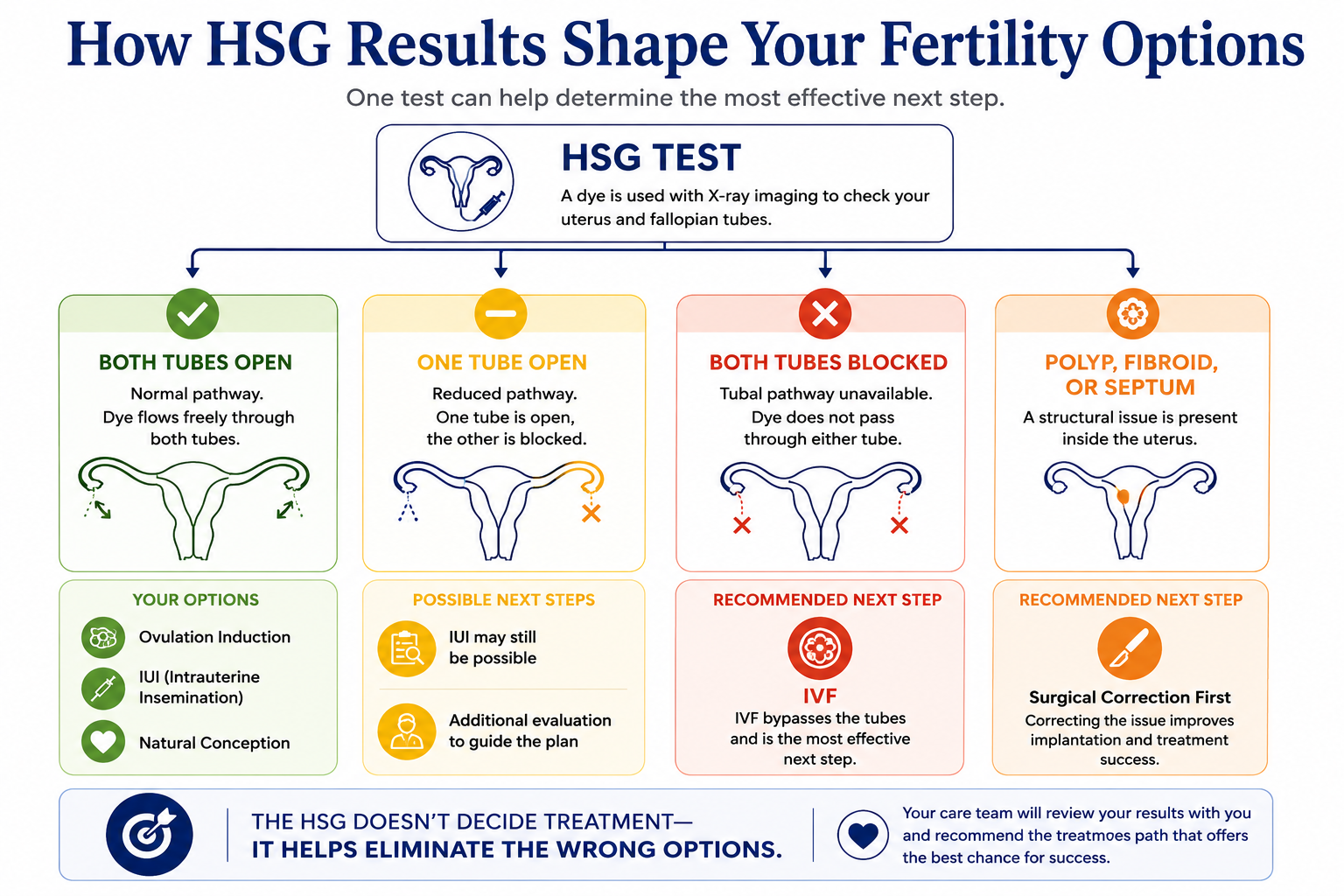
An HSG almost always moves the needle one way or the other. Either it clears the structure as a problem, or it turns up something that reshapes the plan before you’ve taken a single medication.
If both tubes are blocked, IUI comes off the table, since it relies on working tubes, and the conversation turns to IVF, which skips the tubes entirely.
If one tube is open and one is blocked, IUI is still on the table, though with lower odds, and the team weighs that against the rest of your picture before recommending anything. If the HSG turns up a problem inside the uterus, surgery usually comes first, because a distorted cavity works against implantation no matter which treatment follows.
If the HSG comes back clean, planning moves to first-line treatment. For women who don’t ovulate predictably, that often means ovulation induction, with or without IUI, depending on everything else the workup found.
Scheduling an HSG in Jersey City
The Journal Square office is one of the easier fertility clinics to reach in the area, especially without a car. It sits right at the PATH station, so patients come in from Manhattan, Hoboken, Bayonne, and across Hudson County, including West New York, Union City, North Bergen, Kearny, and Secaucus. There’s limited parking behind the building and street parking nearby.
Patients are instructed to call the office when their period starts to set up the HSG. We do not schedule the procedure for patients at their initial consultation.
Virtual consultations are available if you’d rather talk to a physician before coming in. If trying to conceive has brought you this far, request an appointment through the How to Begin page, and a physician will outline the workup that fits your situation. If you’re closer to the Shrewsbury or Newark offices, you can ask for either of those instead.
Frequently Asked Questions
Is the HSG test painful?
The HSG causes cramping for most women, worst in the moments the dye enters the uterus and moves through the tubes. Most describe it as a strong period cramp. Ibuprofen 30 to 60 minutes beforehand takes the edge off, and the cramping usually fades within a few hours.
When during my cycle is the HSG done?
The HSG is done between Days 6 and 13 of the cycle, after your period ends and before you ovulate. Damien Fertility Partners schedules it around your cycle from the first consultation, so the timing doesn’t hold up the rest of your workup.
Is there any benefit to an HSG beyond the diagnosis?
Yes. Studies have found that 10 to 15% of women conceive in the three cycles after an HSG, more than you’d expect over that period without it. The effect is strongest with oil-based contrast, and the likeliest reason is that the dye clears minor blockages in the tubes that were slowing sperm down.
What happens if the HSG shows my tubes are blocked?
If both tubes are blocked, IUI won’t work, and the plan shifts to IVF, which bypasses the tubes. If one tube is open, IUI may still be worth considering depending on the rest of your case. When the blockage sits near the uterus, a procedure called selective salpingography is sometimes an option before IVF. Your physician walks through the images and the recommended path based on what your specific results show.
Does the HSG replace the rest of the fertility evaluation?
No. The HSG checks the shape of the uterus and whether the tubes are open, and nothing about egg supply, egg quality, ovulation, or sperm. At Damien Fertility Partners, it’s one part of a full initial workup that also includes cycle-day bloodwork and semen analysis, so the recommendation rests on the whole picture instead of one result.