
HSG Test in Newark, NJ | Damien Fertility Partners

An HSG test, or hysterosalpingogram, is an X-ray that checks whether your fallopian tubes are open and whether the inside of your uterus is shaped normally. If you have been trying to conceive without success, it is one of the first things a fertility doctor will want to look at. At Damien Fertility Partners in Newark, the HSG is ordered and read as part of the initial workup for patients across Essex County.
The Newark office offers the same diagnostic and fertility services as the rest of the practice, so the HSG sits alongside hormone bloodwork, ovarian reserve testing, and semen analysis in one evaluation.
You will find the office at 60 Park Place, Suite 210, open Mondays and Wednesdays from 7:00am to 5:00pm and Thursdays from 1:00pm to 6:00pm. Spanish-speaking staff are on site, and patients who prefer it can go through the entire process in Spanish.
Not sure whether you need an HSG at all? That is exactly what the first consultation sorts out. Start with the How to Begin page and the team will tell you what your workup should include.
What an HSG Test Actually Shows
During an HSG, a thin catheter delivers a contrast dye into your uterus, and live X-ray follows that dye as it fills the cavity and moves out through the tubes. The doctor watches it happen in real time and learns two things at once.
First, the shape of the uterine cavity. A polyp, a fibroid pressing in from the wall, or a septum dividing the cavity can all interfere with implantation, and the dye outlines them clearly.
Second, whether the tubes are open. If dye spills freely out the end of each tube, that tube is clear. If it stops partway, there is a blockage, and the image shows roughly where it sits.
The test runs between Days 6 and 13 of your cycle, after your period ends and before you ovulate. That timing rules out any chance of the procedure overlapping with a newly released egg.
Where the HSG Stops
An HSG looks at plumbing, not function. It maps the physical structures and finds the obstacles, but it tells you nothing about egg quality, ovarian reserve, whether you ovulate on schedule, sperm health, or whether an embryo can implant.
So a clean HSG is good news, but it is not the whole answer. It rules out mechanical problems and clears the way to examine hormonal and biological factors, which is why it is one part of a full fertility evaluation rather than a standalone verdict.
There is a bonus that surprises many patients. Conception rates tend to tick up in the months right after an HSG, slightly above what you would expect otherwise. The likely reason is that the dye flushes minor debris out of the tubes and clears the path for sperm. A randomized trial in the New England Journal of Medicine found this effect depends on the dye itself: oil-based contrast produced an ongoing pregnancy rate of 39.7% in the six months afterward, compared with 29.1% for water-based contrast.
Reading the Results: Normal or Not
A normal HSG shows a smooth, evenly shaped cavity with dye spilling out of both tubes into the surrounding space. That spill is the whole point. It is the proof that both tubes are open.
An abnormal result points somewhere specific. Dye that stalls before it spills indicates a blocked tube, and the image shows whether the blockage is near the uterus or farther out toward the ovary. A ragged or interrupted outline inside the cavity suggests a polyp, a submucosal fibroid, or a septum. Either way, your doctor walks you through the film and its meaning, rather than handing you a result to puzzle over alone.
What the Appointment Is Like
The HSG is performed in a radiology suite, not in the clinic, and the images are sent to your physician at Damien Fertility Partners for review.
It starts like a regular pelvic exam. A speculum goes in so the doctor can reach the cervix, then a thin catheter passes through the cervix into the uterus. The dye goes in through that catheter while the X-ray records how it travels and whether it reaches and spills from each tube.
The imaging takes about 15 to 30 minutes. Most patients experience cramping when the dye is injected, comparable to a strong period cramp, and it usually eases within a few hours. Counting check-in and recovery, you are generally out in under an hour.
Before and After
There is not much to do beforehand. Take 400 to 600 milligrams of ibuprofen about 30 to 60 minutes ahead, and you will blunt most of the cramping. If you have had pelvic inflammatory disease in the past, your doctor may add a short course of antibiotics first, since that history raises the small chance of infection from the procedure.
Bring a pad. Contrast dye drains for a few hours afterward, and light spotting is normal. Most patients head back into their day without missing a beat.
Call the office if you run a fever, your pelvic pain gets worse instead of better after the first day, or you notice unusual discharge over the following days. Infection is uncommon, but those are the signs of it.
How the Result Steers Your Treatment
The HSG is performed early in the workup for practical reasons. What it finds decides which doors are open.
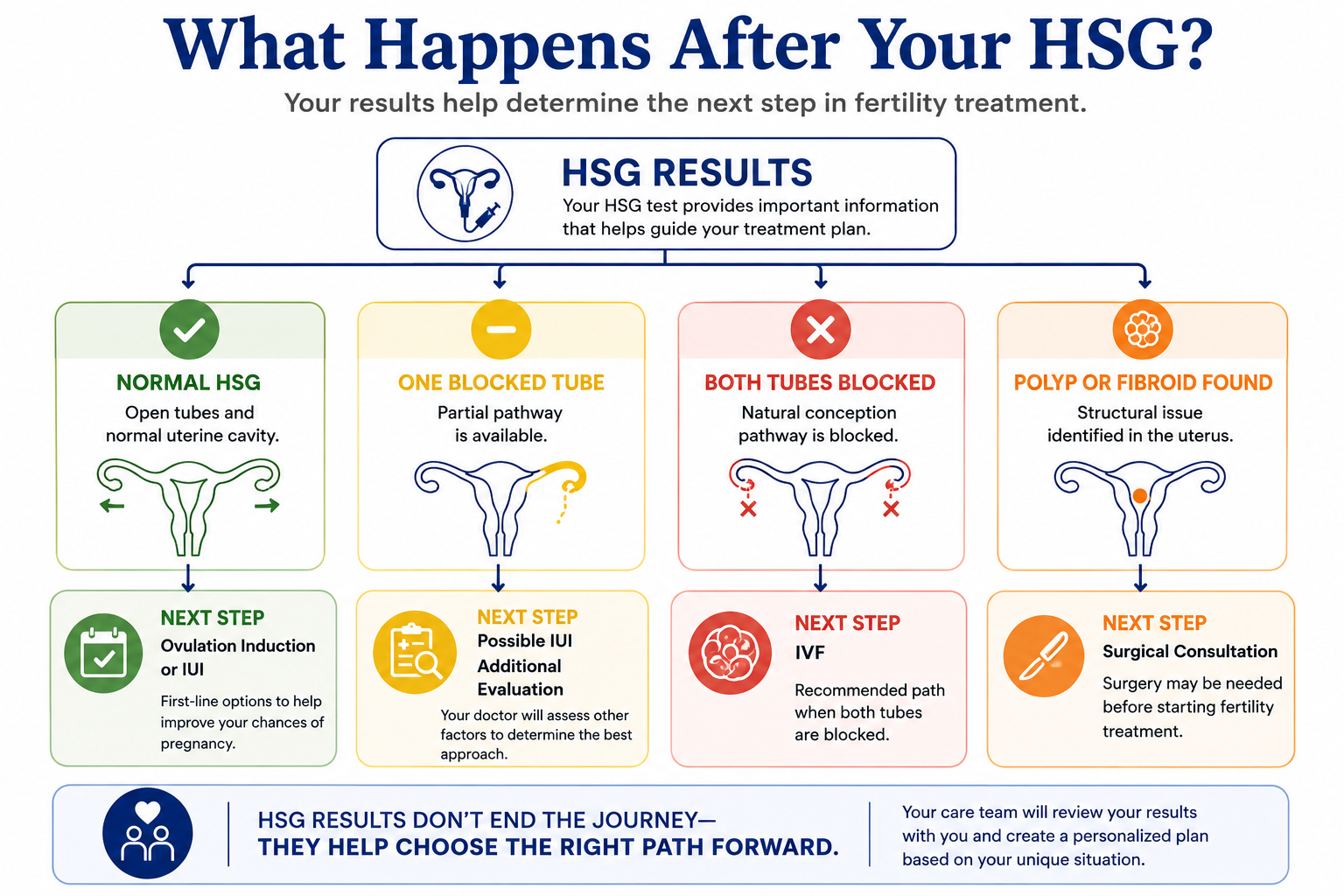
If both tubes are blocked, IUI is off the table, because it depends on sperm reaching the egg through a working tube. The plan moves to IVF instead.
One blocked tube lowers the odds with IUI but does not always rule it out, depending on the rest of the picture. A polyp or submucosal fibroid inside the cavity usually calls for surgical correction before any fertility treatment starts.
When the HSG comes back clean, treatment usually begins with first-line options. For patients who do not ovulate reliably, that often means ovulation induction, frequently paired with IUI. A normal result is not a guarantee of pregnancy, but it resolves the structural questions, allowing the focus to shift to everything else.
Booking an HSG in Newark
The Newark office at 60 Park Place draws patients from across Essex County, including Bloomfield, Belleville, Nutley, Montclair, East Orange, Irvington, and Maplewood. You can walk to it from Newark Penn Station, and NJ Transit buses run along Park Place, so getting there without a car is realistic.
For parking, the Military Park Garage at 42 to 50 Park Place sits directly across the street with hourly and daily rates, and the One Newark Center deck at 42 Mulberry Street is two blocks away.
The HSG is not performed during the initial consultation. Instead, patients are instructed to call the office when their period starts to set up the HSG with either Dr. Damien or Dr. Peters at the Shrewsbury Surgery Center or an imaging center near them. We do not schedule the procedure for patients at their initial consultation. This ensures the procedure is timed precisely within the required window of your cycle.
Frequently Asked Questions
Is the HSG test painful?
Most patients feel cramping when the dye enters the uterus, similar to a strong period cramp, and it usually fades within a few hours. Taking ibuprofen beforehand takes the edge off for most people. The imaging itself only lasts about 15 to 30 minutes.
When in my cycle is the HSG done?
The HSG is performed between Days 6 and 13 of your cycle, after your period ends and before ovulation. Patients are instructed to call the office when their period starts to set up the HSG with either Dr. Damien or Dr. Peters at the Shrewsbury Surgery Center or an imaging center near them, as the procedure is not scheduled during the initial consultation.
Can an HSG actually help me get pregnant?
Conception rates do rise in the months after an HSG, above the normal baseline for that stretch of time. The dye appears to clear minor debris from the tubes that was slowing sperm down. The test is meant to be diagnostic, but this side benefit shows up consistently in the research.
Does an HSG replace my other fertility tests?
No. It checks the structure of your uterus and tubes but says nothing about egg quality, ovarian reserve, ovulation, or sperm. It works alongside hormone bloodwork and semen analysis to build the full picture before anyone recommends treatment.
What happens if the HSG finds something?
The finding sets the next step. Blocked tubes point toward IVF, and a polyp or fibroid usually means a surgical consultation first. A blockage close to the uterus can sometimes be opened with a targeted procedure called selective salpingography. Your doctor goes through whatever shows up and what it means for your options.