
HSG Test Near Hoboken, NJ | Damien Fertility Partners

When a physician recommends an HSG test, or hysterosalpingogram, it usually means a fertility evaluation is underway, and this particular X-ray procedure has been identified as a necessary step.
The HSG examines the inside of the uterus and checks whether the fallopian tubes are open, providing structural information that cannot be obtained from bloodwork or ultrasound alone. For patients in Hoboken and the surrounding Hudson County waterfront communities, the nearest Damien Fertility Partners office is in Jersey City, at Journal Square, approximately 10 minutes from Hoboken Terminal via PATH.
The Jersey City office at One Journal Square Plaza, Suite 301-A, Jersey City, NJ 07306, offers the full scope of Damien Fertility Partners’ fertility evaluation and diagnostic services, including the HSG, ovarian reserve testing, hormonal bloodwork, and semen analysis, with appointments Monday through Friday from 7:00 am to 5:00 pm.
To arrange an initial consultation and confirm whether an HSG is indicated for your workup, call 201-377-0500 or visit the How to Begin page.
What Is an HSG Test?
An HSG is ordered when a physician needs to determine whether the uterine cavity is normal in shape and whether the fallopian tubes are clear. These two pieces of information have direct bearing on which fertility treatments are appropriate and which are not, so the test is typically among the first ordered rather than one of the last.
The procedure uses contrast dye and X-ray fluoroscopy. The dye is introduced into the uterine cavity through a thin catheter, and real-time X-ray images capture how it fills the uterus and whether it passes through both fallopian tubes.
The HSG is performed between Days 6 and 13 of the menstrual cycle, after bleeding has stopped but before ovulation, which keeps the procedure safely outside any window in which conception might have occurred in that same cycle.
What the HSG Evaluates
The HSG produces findings across two structural categories: the uterine cavity and the fallopian tubes. Each category carries specific clinical implications.
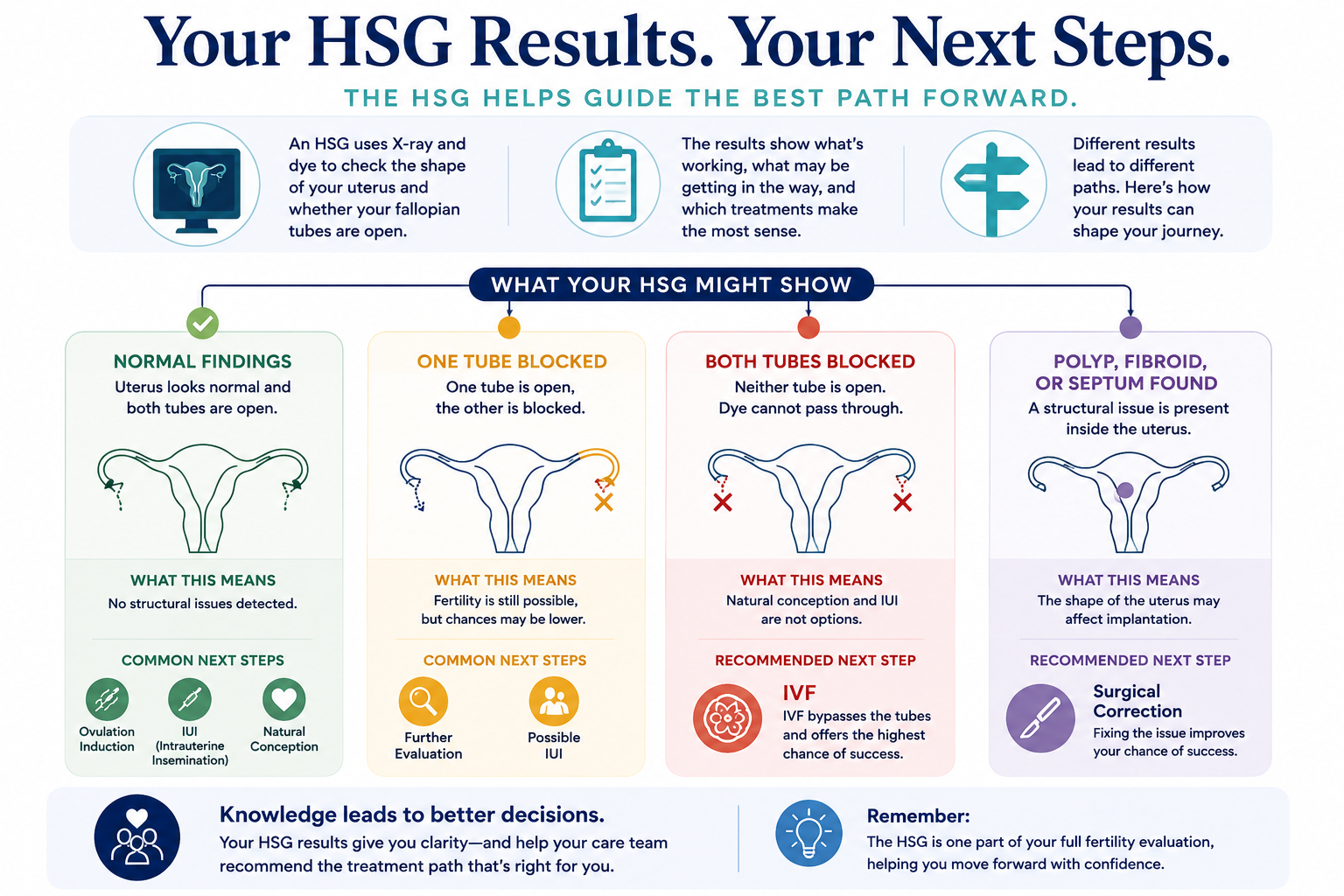
Within the uterine cavity, the HSG can reveal whether its shape is normal or distorted by a polyp, a submucosal fibroid pressing into the cavity, or a uterine septum dividing it. These abnormalities, if present, affect implantation and are typically addressed surgically before fertility treatment begins.
For the fallopian tubes, the HSG determines whether each tube is open and allows the dye to pass through freely, whether one or both tubes are partially or completely obstructed, and whether either tube shows signs of hydrosalpinx, a condition where the tube has filled with fluid and dilated. Each of these findings affects whether IUI is viable and what the recommended treatment path will be.
The HSG is a structural test and does not evaluate ovarian reserve, egg quality, ovulatory function, or sperm. It is one component within a complete fertility evaluation that includes hormonal bloodwork and semen analysis. A normal HSG confirms the anatomy supports conception but does not rule out other factors that the broader workup is designed to assess.
There is one additional dimension worth knowing. Research has found that approximately 10 to 15% of patients who undergo an HSG conceive in the three cycles following the procedure, at a rate higher than expected for the same period without the test. The most widely accepted explanation is that the dye clears minor obstructions in the tubal channels that were impeding sperm transit.
What Happens During the Procedure
The HSG appointment begins like a routine pelvic exam. The patient is positioned on an exam table, a speculum is placed, and a thin flexible catheter is passed through the cervical opening into the uterine cavity.
Contrast dye is then slowly introduced through the catheter. A fluoroscope positioned above the patient captures X-ray images in real time as the dye fills the uterine cavity and moves toward the tubes.
When dye spills freely from the end of a tube, that tube is confirmed open. Where dye stops short, the image shows the location and character of the obstruction.
The imaging takes approximately 15 to 30 minutes. Cramping is common as the dye enters the uterus and travels through the tubes, and most patients describe it as similar to strong menstrual cramps. The full appointment typically runs under one hour, and most patients return to normal activities the same day.
Timing, Preparation, and What to Expect Afterward
Because the HSG must be scheduled within a specific window of the menstrual cycle, Days 6 through 13, the patient is responsible for contacting the office to schedule the procedure once their period begins. The timing and process are discussed at the initial consultation, but the appointment is not booked for you at that time. This ensures the test is performed in the correct cycle window after your evaluation has started.
Before the procedure, taking 400 to 600 milligrams of ibuprofen approximately 30 to 60 minutes beforehand reduces the cramping that most patients experience during the dye injection. For patients with a prior history of pelvic inflammatory disease, the physician may prescribe a brief antibiotic course to reduce the already low risk of infection.
After the HSG, some contrast dye drains vaginally over several hours, so wearing a pad is recommended. Light spotting is normal for one to two days following the test. Fever, increasing pelvic pain beyond the first 24 hours, or unusual discharge should prompt a call to the clinic, as these can be early signs of pelvic infection, which is uncommon but worth evaluating promptly.
How the HSG Result Shapes Your Treatment Path
Of all the tests in the initial fertility workup, the HSG is often the one that most directly determines which treatments are on the table and which are not. Its findings do not exist in isolation, but they carry substantial weight in the clinical decision that follows.
When both fallopian tubes are blocked, the treatment path shifts immediately. IUI depends on functional tubes, so a bilateral obstruction removes it from consideration and points the evaluation toward IVF, which retrieves eggs directly from the ovaries and bypasses the tubes entirely.
When one tube is open, IUI may remain an option depending on other clinical findings, though expected success rates are lower than with two open tubes. When the HSG identifies a uterine abnormality, surgical correction is typically the recommended step before any fertility treatment begins.
When both the uterus and tubes appear normal, the workup proceeds to treatment planning based on the remaining evaluation results. For patients with irregular or absent ovulation, ovulation induction combined with IUI is a common starting point.
Getting an HSG Near Hoboken at Damien Fertility Partners
Hoboken patients have convenient access to the Damien Fertility Partners Jersey City office via the PATH train from Hoboken Terminal to Journal Square, a direct ride that takes approximately ten minutes. The office at One Journal Square Plaza sits at the Journal Square PATH station exit, making the commute straightforward for patients who work in or travel through the area.
Limited parking is also available behind the office building, and street parking may be found in the surrounding blocks for patients who prefer to drive from Hoboken, Weehawken, Edgewater, Fort Lee, or Cliffside Park.
The HSG is arranged as part of the initial consultation rather than booked separately. To begin, call 201-377-0500 or submit a request through the How to Begin page. Patients who prefer a location in Shrewsbury or Newark are also welcome to request an appointment at either of those offices.
Frequently Asked Questions
Where can I get an HSG test near Hoboken?
Damien Fertility Partners performs HSG referrals and interpretations at its Jersey City office, located at One Journal Square Plaza, Suite 301-A, Jersey City, NJ 07306. The office is accessible from Hoboken Terminal via a direct PATH ride to Journal Square, approximately ten minutes. To schedule, call 201-377-0500 or visit the How to Begin page.
Does the HSG hurt?
Most patients experience cramping when the contrast dye is introduced into the uterine cavity, typically described as similar to strong menstrual cramps. The discomfort usually passes within a few hours. Taking ibuprofen 30 to 60 minutes before the procedure reduces cramping for most patients, and the imaging itself takes approximately 15 to 30 minutes.
Can I get pregnant in the cycle after an HSG?
Yes, and the cycles immediately following an HSG may carry a modest boost in conception probability. Research has found that approximately 10 to 15% of patients conceive within three cycles after the procedure, a rate that exceeds the expected baseline for that period. The leading explanation is that the contrast dye clears minor impediments in the fallopian tubes that were limiting sperm access to the egg.
What if the HSG shows one of my tubes is blocked?
If one tube is blocked, IUI may still be considered depending on the specific location of the blockage and other clinical factors, though expected success rates are lower than with two open tubes. If both tubes are blocked, IUI is not viable, and the evaluation moves to IVF planning. A proximal blockage, near where the tube connects to the uterus, may sometimes be treated with a targeted procedure called selective salpingography before proceeding to IVF.
What is included in the fertility evaluation beyond the HSG?
At Damien Fertility Partners, the initial fertility evaluation includes the HSG alongside cycle day hormonal bloodwork to assess ovarian reserve and ovulatory function, and a semen analysis for the male partner. Together, these tests cover the structural, ovarian, and sperm factors that most commonly contribute to difficulty conceiving. Additional testing is ordered based on what the initial workup reveals.