
HSG Test Near Red Bank, NJ | Damien Fertility Partners

If your doctor has referred you for an HSG test, it means two things need a closer look: the shape of the inside of your uterus, and whether your fallopian tubes are open. An HSG, short for hysterosalpingogram, is an X-ray procedure that answers both questions in one short appointment. For anyone in Red Bank or the surrounding Monmouth County shore area, the closest Damien Fertility Partners office is in Shrewsbury, under three miles from downtown.
The Shrewsbury office at 655 Shrewsbury Avenue, Shrewsbury, NJ 07702, handles the full range of Damien Fertility Partners fertility evaluation services: HSG referrals and interpretation, hormonal bloodwork, ovarian reserve testing, and semen analysis. The office is open Monday through Friday, 7:00 am to 5:00 pm, with parking directly next to the building.
An HSG is never ordered in isolation. It is one piece of a broader workup, which is why it starts with a consultation rather than a standalone booking. Once the test is ordered, patients are responsible for scheduling the procedure themselves with the radiology facility to ensure it aligns with their cycle. You can request that first appointment through the How to Begin page.
What Is an HSG Test?
The procedure itself is simple. A thin catheter carries contrast dye into the uterine cavity, and X-ray imaging tracks where that dye goes. If it flows through both tubes and spills out the ends, the tubes are open. If the cavity fills evenly without distortion, its shape is normal. Two questions, one set of images.
Nothing else in a standard workup answers those questions. Bloodwork measures hormones. A routine ultrasound can spot an ovarian cyst or measure the uterine lining, but it cannot confirm whether the tubes are clear or detect subtler distortions within the cavity that interfere with implantation. The HSG is the test that fills that gap.
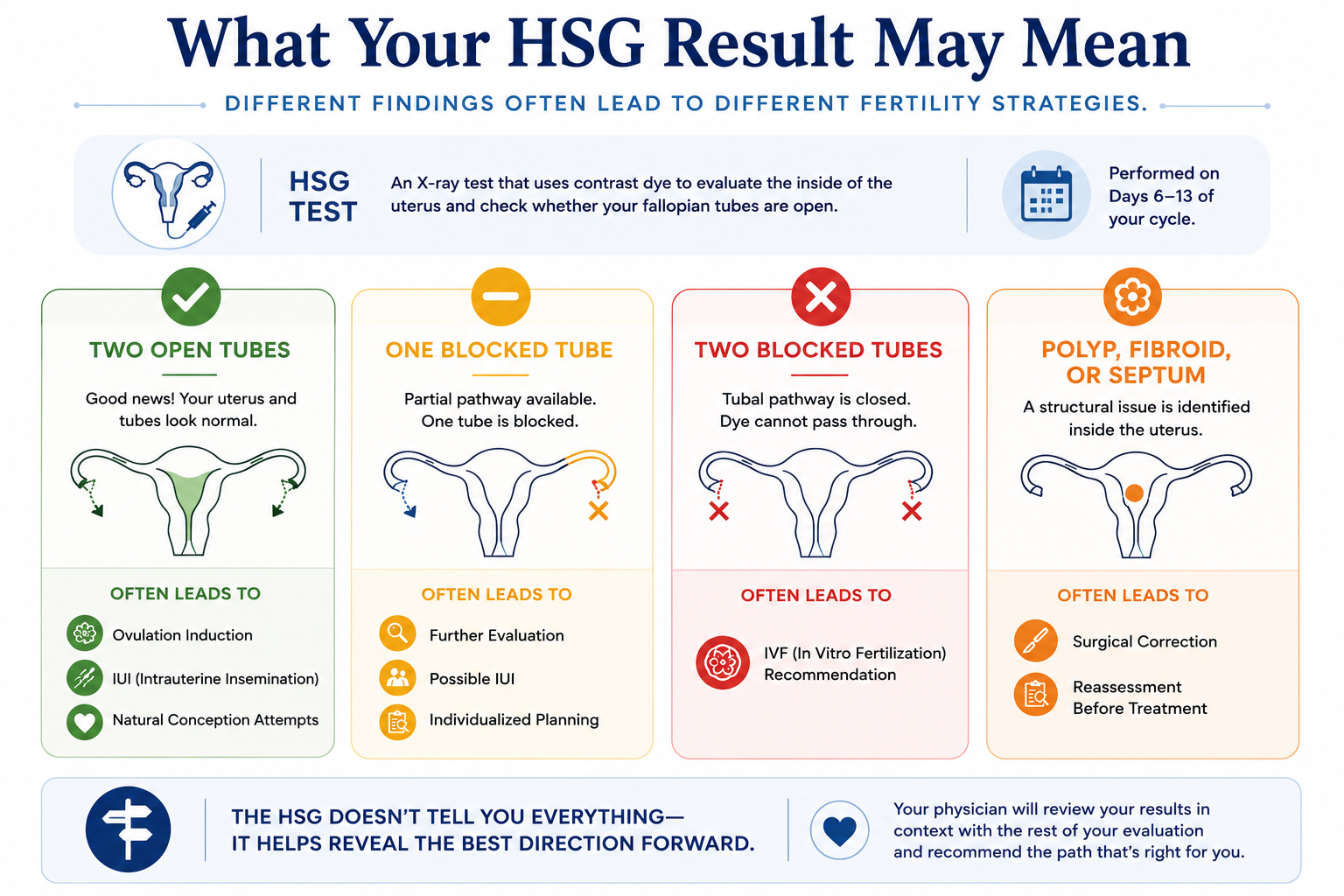
Timing matters. The HSG is performed between Days 6 and 13 of your cycle, after bleeding has stopped and before ovulation. That window rules out any chance of the dye reaching an egg that has already been released.
What an HSG Can and Cannot Tell You
An HSG answers structural questions, and the answers steer which treatments make sense.
Open tubes are the first thing it checks. A blocked tube stops sperm from reaching the egg on its own, which takes IUI off the table and moves the conversation toward IVF. A tube that has filled with fluid, a condition called hydrosalpinx, needs its own treatment before any fertility cycle begins.
The shape of the uterine cavity is the second. Polyps, submucosal fibroids, and a uterine septum each distort the cavity in ways that can block an embryo from implanting, and none of them show up reliably on a standard pelvic ultrasound. The HSG catches them, as does a related test called a sonohysterogram.
What an HSG will not tell you is just as worth knowing as what it will. It says nothing about ovarian reserve, egg quality, ovulation, or sperm. A clean HSG confirms that the plumbing is intact, but it does not rule out other reasons why conception might be difficult. That is why the full fertility evaluation at Damien Fertility Partners pairs the HSG with hormonal bloodwork and semen analysis, so the structural and functional pictures come together.
There is also a long-noted side effect worth mentioning. Some patients conceive in the months right after an HSG, and the working theory is that the dye flushes minor debris or mucus from the tubes that had been slowing sperm.
What the Appointment Itself Is Like
Your HSG happens at a radiology facility, not in the clinic office. Plan on the procedure taking 15 to 30 minutes and being in and out within an hour, including check-in and a short recovery.
Once you are on the table, a speculum is placed the same way it is during a routine pelvic exam, and a thin, flexible catheter is passed through the cervix into the uterus. The dye then flows in while a fluoroscope captures live X-ray images. The radiologist watches it fill the cavity and travel toward each tube. Free spill from both ends means open tubes. Where the dye stalls, the image shows exactly where the blockage sits.
Most people feel cramping when the dye goes in, close to strong menstrual cramps. It varies from person to person, and for most it is manageable and fades within two to three hours.
How to Prepare, and What Comes After
Take 400 to 600 milligrams of ibuprofen about 30 to 60 minutes before your appointment. It is the single most useful thing you can do to ease cramping, and it requires no prescription.
If you have a history of pelvic inflammatory disease, tell your Damien Fertility Partners physician at the first consultation. A short course of antibiotics beforehand lowers the already small risk of infection.
Bring a pad. Some dye drains for a few hours afterward, and light spotting for a day or two is normal. Most people go back to their usual routine the same day. Call the clinic if you run a fever, your pelvic pain worsens after the first day, or you notice unusual discharge, as these can indicate an infection.
What Each Result Means for Your Next Step
Every HSG result hands your physician a specific piece of the plan.
Two open tubes and a normal cavity means the focus shifts to what the rest of the workup shows. If ovulation is the issue, ovulation induction paired with IUI is a common starting point.
One blocked tube still leaves IUI on the table, though with lower expected success. The team weighs where the blockage is and what it looks like against the rest of the findings before recommending a course of action.
Two blocked tubes point to IVF, which retrieves eggs straight from the ovaries and skips the tubes entirely. A uterine abnormality usually calls for surgical correction before a fertility cycle starts.
Getting an HSG Near Red Bank at Damien Fertility Partners
The Shrewsbury office sits about a five to ten-minute drive from downtown Red Bank along Route 35, with a parking lot next to the building. Patients from Rumson, Fair Haven, Little Silver, Oceanport, Sea Bright, and Eatontown are at a similar distance. Anyone closer to the Newark or Jersey City offices may find one of those easier to reach.
Because the HSG is timed to specific days of your cycle, the referral is provided at your first visit. However, the clinic does not book this appointment for you. Patients must contact the radiology facility to schedule the HSG for the appropriate window in their cycle (typically Days 6 through 13). The physician reviews your history and orders the parts of the evaluation that apply, providing you with the necessary referral to take to a radiology facility. If you are working through possible tubal or uterine factors, start with a consultation through the How to Begin page and the team will provide the guidance you need to schedule your testing.
Frequently Asked Questions
Where can I get an HSG test near Red Bank, NJ?
Damien Fertility Partners in Shrewsbury is the closest option for Red Bank patients, at 655 Shrewsbury Avenue, Shrewsbury, NJ 07702, about three miles from downtown. The office is open Monday through Friday, 7:00 am to 5:00 pm. You can request a consultation through the How to Begin page.
How painful is the HSG?
Most patients feel cramping when the contrast dye enters the uterus, similar to strong menstrual cramps. It is short-lived and usually eases within a few hours. Taking ibuprofen 30 to 60 minutes ahead of the appointment is the main step that reduces it for most people.
When in my cycle is the HSG performed?
The HSG is scheduled between Days 6 and 13 of the menstrual cycle, after bleeding stops and before ovulation. While Damien Fertility Partners provides the referral and timing guidance at your first consultation, you are responsible for contacting the radiology facility to book the appointment within that specific window.
What should I expect after the HSG?
Most patients have mild cramping and some dye drainage for a few hours, with light spotting common for a day or two. Normal activity can usually resume the same day. A fever, worsening pelvic pain, or unusual discharge in the days after should be reported to the clinic, since those can signal infection.
Does an HSG use radiation, and is that a concern?
An HSG uses fluoroscopy, a low-dose form of X-ray imaging, and the exposure is small and brief. Because the test is scheduled in the first half of the cycle before ovulation, there is no risk to a pregnancy. If you have questions about radiation, the team can walk you through what the facility uses at your consultation.