
HSG Test Near Freehold, NJ | Damien Fertility Partners

An HSG test, or hysterosalpingogram, is the only non-surgical way to see directly inside the fallopian tubes. It uses contrast dye and X-ray imaging to show whether the tubes are open and to check the shape of the uterine cavity. For patients in Freehold and the surrounding central Monmouth County area, the closest Damien Fertility Partners office is in Shrewsbury, about 20 to 25 minutes east along Route 9.
The Shrewsbury office at 655 Shrewsbury Avenue, Shrewsbury, NJ 07702, handles the full fertility evaluation and diagnostic workup, which includes the HSG, hormonal bloodwork, ovarian reserve testing, and semen analysis. The office is open Monday through Friday, 7:00 am to 5:00 pm, and there is a parking lot right next to the building.
If you want to find out whether an HSG belongs in your workup, the How to Begin page includes a request form you can fill out to schedule a consultation.
What an HSG Test Shows and Why It Gets Ordered
A physician orders an HSG when they need structural information that no other standard test can give them. Bloodwork tells you about hormones and ovarian reserve. Ultrasound shows ovarian structure and the uterine lining. Neither one can confirm whether the fallopian tubes are open or detect certain problems within the uterine cavity.
Here is what happens during the test. A thin catheter carries contrast dye into the uterine cavity, and live X-ray imaging follows the dye as it moves through the uterus and into the tubes. The images show the inside contours of the cavity and whether dye passes freely through both tubes.
The HSG is done between Days 6 and 13 of the menstrual cycle, after bleeding has ended but before ovulation. That timing rules out any chance of the procedure overlapping with the release of a newly released egg.
How HSG Findings Change Your Treatment Path
What makes the HSG worth doing is how much it can redirect the plan. Depending on what the images show, the next step shifts in a fairly predictable way.
If both tubes are open and the uterine cavity looks normal, the workup continues based on whatever the hormone and sperm testing turn up. For patients with irregular cycles or anovulation, ovulation induction paired with IUI is a common place to start.
If one or both tubes are blocked, the picture changes. A blockage in both tubes takes IUI off the table, since that procedure relies on open tubal pathways, and the plan moves toward IVF. A single blocked tube lowers IUI success rates but does not always rule it out.
When the HSG turns up a uterine problem, such as a polyp, a submucosal fibroid pushing into the cavity, or a uterine septum, surgical correction usually comes first, before any fertility treatment. Cavity abnormalities left alone can interfere with implantation whether the embryo arrives through IUI or IVF.
The HSG does not measure ovarian reserve, egg quality, ovulation, or sperm. Those are assessed individually through hormonal bloodwork and semen analysis, both of which are part of the initial evaluation at Damien Fertility Partners. A real diagnosis pulls all those findings together rather than relying on any single test.
There is also a smaller upside that often surprises patients. Some research has found that a share of patients conceive in the cycles right after an HSG, possibly because the dye nudges minor debris or mucus out of the tubal channels. The effect is modest and not guaranteed, but it is a documented bonus rather than the reason the test gets ordered.
Reading a Normal Result Against an Abnormal One
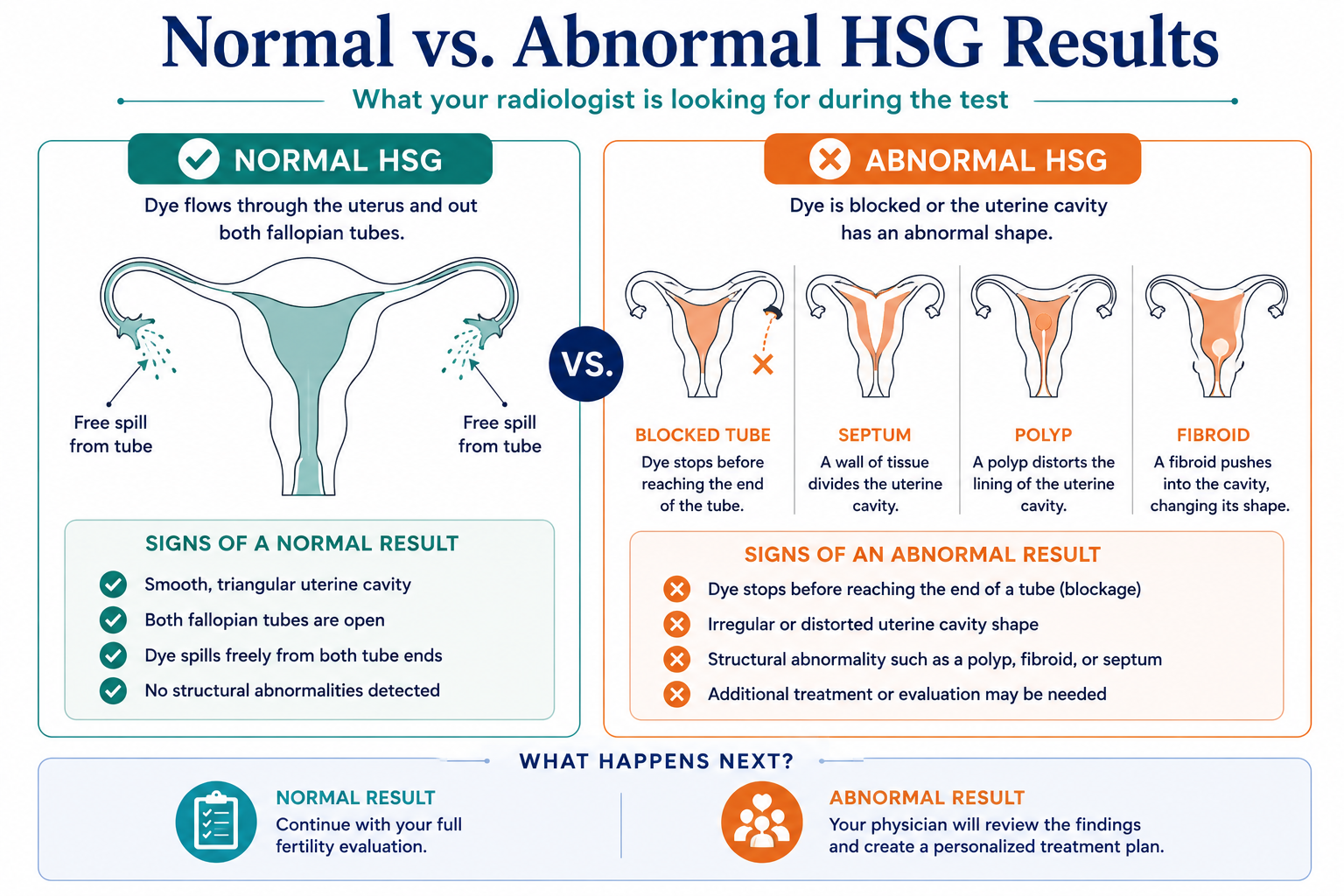
It helps to know what the radiologist is actually looking for on the screen. A normal HSG has two features. The uterine cavity fills evenly with a smooth, roughly triangular outline, and the dye spills out the far ends of both tubes into the surrounding space. That free spill is the clearest sign the tubes are open.
An abnormal result breaks one of those patterns. If dye stalls partway along a tube, the image marks the spot where flow stops, indicating the location of a blockage. If the cavity fills with an uneven or irregular shape, that contour usually reflects a polyp, a fibroid, or a septum distorting the space. Either finding gives your physician a concrete starting point for the conversation about what comes next.
What the Radiologist Sees During the Procedure
The HSG takes place at a radiology facility under fluoroscopic guidance, meaning the radiologist watches a live X-ray monitor the entire time as the dye moves through your anatomy.
It starts the way a routine pelvic exam does. You are positioned on the table, a speculum is placed, and a thin catheter is threaded through the cervix into the uterine cavity.
Then the dye flows through the catheter. On the screen, the radiologist watches it outline the cavity and track toward both tubes. A normal result shows the dye spilling freely from the ends of both tubes.
When dye cannot get through a tube, the image shows where it stops. When the cavity fills with an irregular shape, the image shows the distortion. The imaging itself runs about 15 to 30 minutes. Most patients feel cramping as the dye goes in, often described as strong menstrual cramps, and it usually eases within a few hours.
How to Prepare and What the Day Looks Like
The single most useful thing you can do beforehand is take 400 to 600 milligrams of ibuprofen about 30 to 60 minutes before you arrive at the radiology facility. For most patients, that takes the edge off the cramping during the dye injection.
If you have a history of pelvic inflammatory disease, your physician may prescribe a short antibiotic course ahead of time to lower the small risk of infection. That is worth raising at your initial consultation with your Damien Fertility Partners physician.
The appointment usually runs under an hour from check-in to discharge. Bring a pad, since some dye can drain for several hours afterward and light spotting for a day or two is normal.
Most patients go back to their normal day right away. Fever, pelvic pain that climbs after the first 24 hours, or unusual discharge can signal infection, and those are reasons to call the clinic.
Getting an HSG Near Freehold at Damien Fertility Partners
From Freehold, Shrewsbury is roughly 20 to 25 minutes east. The simplest route is north on Route 9, then east on Route 35. Patients from Howell, Manalapan, Marlboro, Englishtown, and Allentown are all facing a similar drive on the same roads.
The HSG is arranged following your initial consultation. Your physician reviews your history at that first visit and decides which parts of the workup apply to you. Because the procedure must be precisely timed to your cycle (Days 6–13), patients are responsible for contacting the clinic as soon as their period starts to schedule the appointment for that month.
If an open or unexplained tubal question is what brought you here, the evaluation and diagnosis process is built to answer it and map out where you go from there. You can start by submitting the request form on the How to Begin page. Patients who would rather use the Newark or Jersey City office are welcome at either.
Frequently Asked Questions
Where can I get an HSG test near Freehold, NJ?
The closest Damien Fertility Partners location for Freehold patients is the Shrewsbury office at 655 Shrewsbury Avenue, Shrewsbury, NJ 07702, about 20 to 25 minutes east via Route 9. The office is open Monday through Friday, 7:00 am to 5:00 pm. You can request an appointment through the form on the How to Begin page.
Does an HSG hurt?
Most patients feel cramping during the procedure as the contrast dye enters the uterine cavity. It is usually compared to strong menstrual cramps and settles within a few hours. Taking ibuprofen 30 to 60 minutes before the appointment reduces cramping for most people.
Can having an HSG improve my chances of getting pregnant?
Some studies have reported a short-term rise in conception in cycles immediately after an HSG, though the magnitude of the effect varies and is not something the test is designed to produce. The leading explanation is that the dye may clear minor debris or mucus from the tubes that was slowing sperm. Your physician can tell you whether this applies to your situation.
When during my cycle is the HSG scheduled?
The HSG is performed between Days 6 and 13 of the menstrual cycle, after bleeding ends and before ovulation. We do not schedule the HSG for you at your initial consultation. Instead, because the procedure must be precisely timed to your cycle (Days 6–13), you are responsible for contacting the clinic as soon as your period starts to schedule the appointment for that month.
What happens if the HSG finds a blocked tube?
If both tubes are blocked, the plan moves to IVF, which bypasses the tubes entirely. If one tube is open, IUI may still be an option, depending on other factors. A blockage close to the uterus can sometimes be treated with a targeted procedure called selective salpingography before IVF is considered, and your physician will walk you through the imaging and the recommended next step.