
HSG Test Near Middletown, NJ | Damien Fertility Partners
 An HSG test near Middletown answers a question that bloodwork and ultrasound cannot: are the fallopian tubes open, and is the inside of the uterus shaped the way it should be. The test uses contrast dye and live X-ray imaging to trace the path an egg and sperm would actually travel. For patients in Middletown Township and the Bayshore communities, the closest option is the Damien Fertility Partners Shrewsbury office, directly adjacent and under ten minutes from most of Middletown via Route 35.
The Shrewsbury office at 655 Shrewsbury Avenue handles the full fertility evaluation, including HSG referral and interpretation, hormonal bloodwork, ovarian reserve testing, and semen analysis. If you are early in the process and want to know whether an HSG belongs in your workup, the evaluation and diagnosis page walks through what a first visit covers and how the pieces fit together.
What an HSG Test Actually Shows
A fertility workup pulls from a few different tests, and each one answers a different question. Blood tests read hormone levels and ovarian reserve. Ultrasound looks at the ovaries and the uterine wall. Semen analysis covers the sperm. None of those can tell a physician whether the tubes are clear or whether the uterine cavity has a normal interior shape. That is the gap the HSG fills.
It matters because the answer changes the treatment plan. A blockage in the tubal pathway can stop sperm from ever reaching the egg. A polyp, fibroid, or septum inside the uterus can interfere with implantation even after fertilization happens. A physician needs to know about both before recommending a path forward.
The test is scheduled between Days 6 and 13 of the menstrual cycle. It runs after bleeding stops, so the cavity is clear enough for the dye to fill cleanly, and before ovulation, so there is no chance of disturbing a newly released egg. The American Society for Reproductive Medicine classifies tubal blockage as a common, identifiable cause of infertility, which is why this single test carries so much weight in the evaluation.
Reading the Radiology Report
After the HSG, a radiologist produces a report, and your Damien Fertility Partners physician reviews it with you. The report answers the same set of structural questions for every patient, and knowing the terms ahead of time makes that conversation easier.
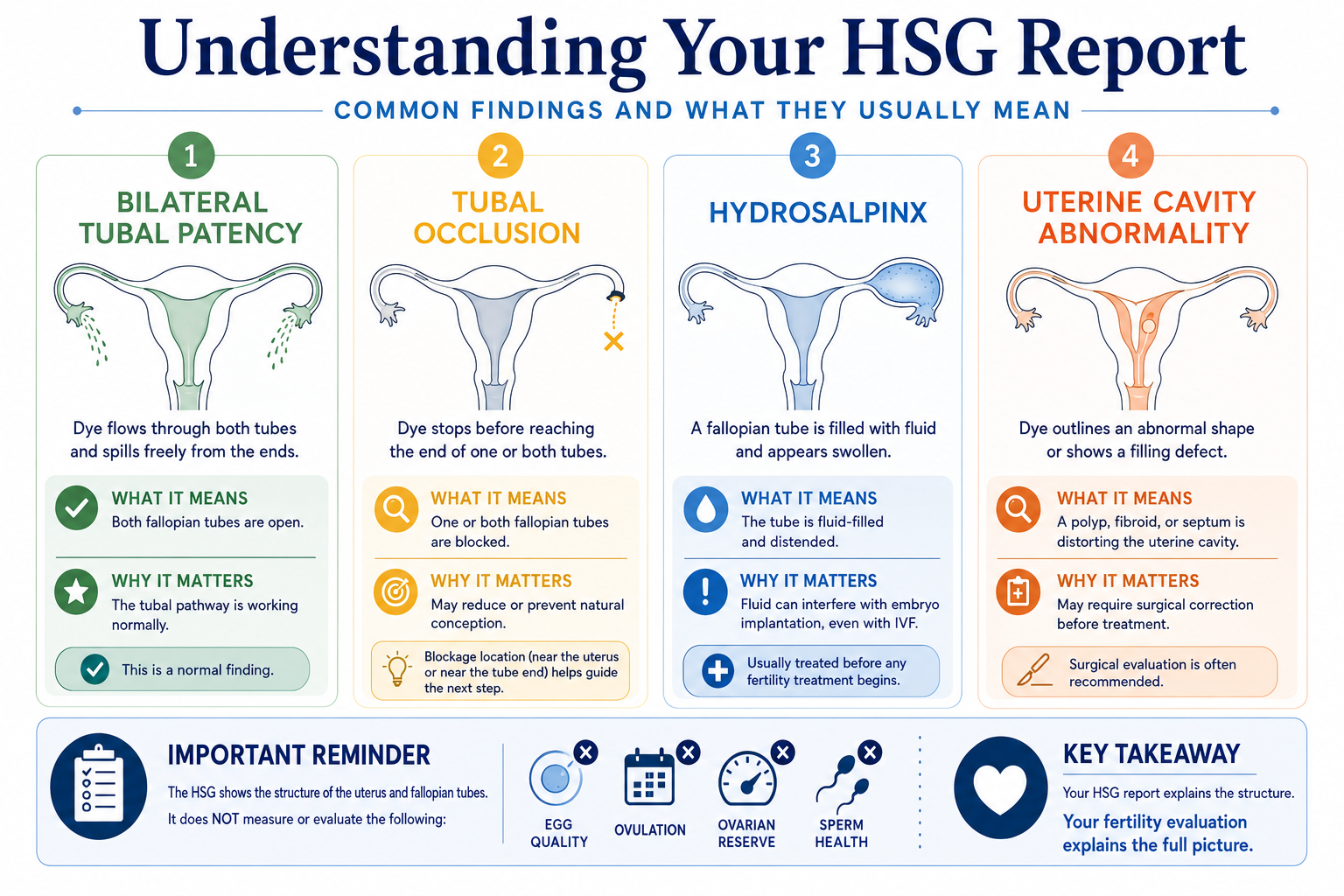
Bilateral tubal patency means both tubes are open. This is the normal finding and confirms the tubal pathway is not the problem.
Tubal occlusion means a blockage on one or both sides. The report notes whether it sits proximally, near the uterine end, or distally, near the fimbriated end. Location drives the next step. Proximal blockages are sometimes treatable with a procedure called selective salpingography, while distal and bilateral blockages tend to point the evaluation toward IVF.
Hydrosalpinx describes a tube that has filled with fluid and swollen. That fluid can interfere with embryo implantation, so it needs specific management before any fertility treatment starts, even IVF.
A uterine cavity abnormality, such as a filling defect from a polyp or submucosal fibroid, or an irregular outline from a septum, usually leads to a recommendation for surgical evaluation before treatment begins.
One thing the HSG does not measure is egg quality, ovarian reserve, ovulation, or sperm. Those come from other parts of the workup, and a physician weighs all of it together before recommending anything.
There is also a small fertility benefit to the test itself. Roughly 10 to 15 percent of patients conceive within three cycles of an HSG, a higher rate than would be expected over that span without it. The leading explanation is that the contrast dye flushes minor debris from the tubes that had been slowing sperm down.
How the Cycle Timing Works
The Days 6 to 13 window is the first practical hurdle most patients hit, because it means the HSG cannot be booked on whatever day happens to be convenient. It has to line up with your cycle.
At Damien Fertility Partners, the clinical team identifies the HSG as a necessary part of your workup during your first consultation. However, because the test must occur within a specific window of your cycle, patients are responsible for contacting the radiology facility to schedule the appointment once their period begins. The team will provide you with the necessary referral and guidance on how to calculate your Day 1 to ensure the test falls inside the correct window.
If your cycles are irregular or you are unsure of your cycle day, say so at the consultation. The team can adjust the timing approach to fit your pattern.
What the Imaging Visit Looks Like
The HSG happens at a radiology facility under fluoroscopic X-ray, not at the clinic office. A radiologist places a thin catheter into the uterine cavity, introduces the contrast dye, and watches on a live screen as it fills the uterus and moves toward the tubes.
A normal result shows the dye filling the cavity in a triangular or pear shape, then running through both tubes and spilling freely from their ends into the pelvis. That free spill on both sides is what confirms the tubes are open.
An abnormal result looks different. The dye might stop short inside a tube, which signals a blockage. It might fill only part of the cavity with ragged borders, which suggests a lesion inside. Or a tube might balloon and hold the dye without releasing it, which fits hydrosalpinx.
The imaging itself runs about 15 to 30 minutes. Cramping is common while the dye goes in, and most patients compare it to strong period cramps. It usually eases within a few hours of leaving.
Before, During, and After the Test
Take 400 to 600 milligrams of ibuprofen about 30 to 60 minutes before you arrive. It blunts the cramping for most people. If you have a history of pelvic inflammatory disease, tell your physician beforehand, since a short course of antibiotics may be worth adding to lower an already small infection risk.
Plan for the visit to run under an hour from check-in through recovery, even though the imaging is brief. Bring a pad, because the dye drains for several hours afterward and light spotting for a day or two is normal. Most patients go back to their usual routine the same day.
Call the office if you run a fever, your pelvic pain gets worse after the first 24 hours, or you notice unusual discharge. Infection after an HSG is uncommon, but those signs are worth checking.
Getting an HSG Near Middletown
Middletown Township sits right next to Shrewsbury, which makes the Shrewsbury office the nearest fertility clinic for most Middletown residents. It is under ten minutes from central Middletown via Route 35, with parking right next to the building, and it runs Monday through Friday from 7:00 am to 5:00 pm.
Patients coming from Lincroft, Navesink, Belford, Leonardo, Atlantic Highlands, Keansburg, Hazlet, and Keyport are all a short drive along Route 35 or Route 36.
If you are ready to start, request a consultation through the How to Begin page, where you can send your information and the team will follow up about scheduling and next steps. Patients who prefer another location can also use the Newark and Jersey City offices.
Frequently Asked Questions
Where can I get an HSG test near Middletown, NJ?
The nearest Damien Fertility Partners office for Middletown patients is at 655 Shrewsbury Avenue in Shrewsbury, under ten minutes from central Middletown via Route 35. The office is open Monday through Friday from 7:00 am to 5:00 pm, and you can request an appointment through the How to Begin page.
What does an HSG feel like?
Most patients feel cramping when the contrast dye enters the uterine cavity, similar to strong menstrual cramps, and it usually settles within a few hours. Taking ibuprofen 30 to 60 minutes beforehand reduces the discomfort for most people.
Can an HSG improve my chances of getting pregnant?
Roughly 10 to 15 percent of patients conceive within three cycles of an HSG, a higher rate than the same span without the test. The explanation best supported by the research is that the dye clears minor debris or mucus from the tubes that had been limiting sperm access to the egg.
When in my cycle is the HSG done?
The HSG is performed between Days 6 and 13 of the menstrual cycle, after bleeding ends and before ovulation. Damien Fertility Partners arranges the scheduling at your first consultation so the test lands inside the correct window.
What happens after the results come back?
Your Damien Fertility Partners physician reviews the report with you and explains what each finding means for treatment. Normal results support first-line options such as ovulation induction with IUI, while blocked tubes or a uterine abnormality shift the recommended path in specific ways your physician will walk through.