
HSG Test Near Toms River, NJ | Damien Fertility Partners

An HSG test answers two questions a fertility doctor needs settled before recommending treatment: are the fallopian tubes open, and is the inside of the uterus shaped the way it should be.
The test, formally a hysterosalpingogram, is one of the first things ordered in a standard workup. For patients in Toms River and the rest of Ocean County, the nearest full-service fertility practice is Damien Fertility Partners in Shrewsbury, a drive of roughly 25 to 35 minutes north on the Garden State Parkway.
The Shrewsbury office at 655 Shrewsbury Avenue handles the HSG as part of a full fertility evaluation that also covers hormonal bloodwork, ovarian reserve testing, and semen analysis. Hours are Monday through Friday, 7:00am to 5:00pm, with parking next to the building.
If you are not sure whether an HSG belongs in your workup, it helps to see where the test fits in the larger picture. The fertility evaluation program lays out how the HSG works alongside the hormonal and sperm testing that rounds out a full diagnosis.
What an HSG Shows That Other Tests Cannot
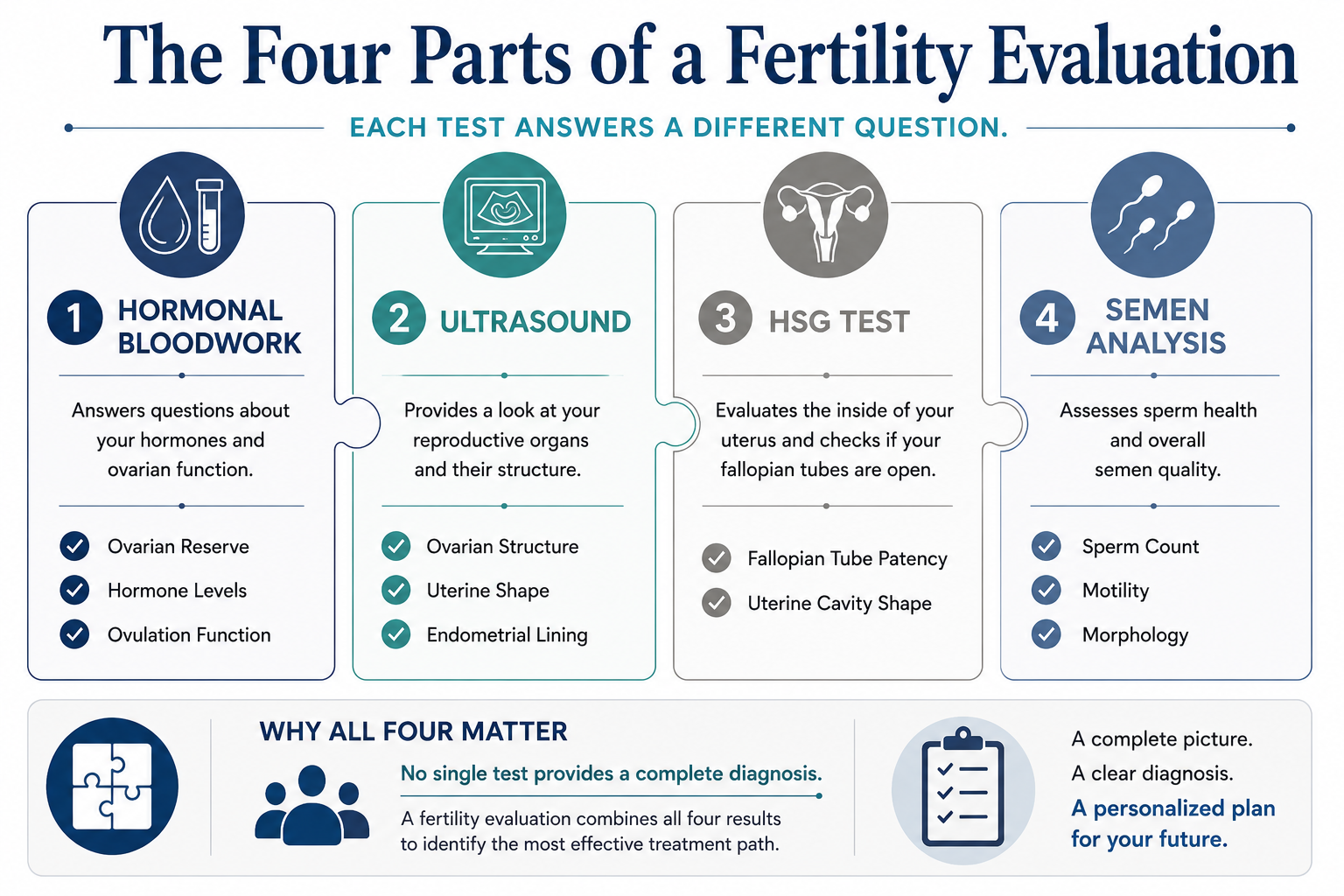
Each part of a fertility workup answers a different question. Hormonal blood tests read ovarian reserve and cycle function. Ultrasound shows the size and shape of the ovaries and the outer contours of the uterus. A semen analysis covers sperm count, motility, and shape.
None of those can see inside the uterine cavity or tell you whether the tubes are open. That is the gap the HSG fills. It uses a contrast dye and live X-ray, called fluoroscopy, to trace the path through the uterus and out through each tube.
Timing matters. The test is scheduled between Days 6 and 13 of the cycle, after bleeding has stopped and before ovulation. That window keeps the cavity clear for a readable image and avoids any contact with a newly released egg.
What the Day Itself Looks Like
The HSG is performed at our on-site radiology facility in our Shrewsbury office. Start to finish, most patients are in and out in under an hour.
A speculum goes in first, then a thin catheter passes through the cervix into the uterus. Dye flows through the catheter while the fluoroscope records X-ray images in real time. The radiologist watches the dye fill the cavity and move toward the tubes. When it reaches the end of a tube and spills into the pelvis, that tube is open. When the dye stops partway, the image marks where the blockage sits.
Cramping is the part people remember. It peaks while the dye is moving and feels like strong period cramps for most patients. The imaging runs about 15 to 30 minutes, and the cramping usually fades within a few hours.
Reading the Results
An HSG turns up a short list of findings, and each one points the next step in a clear direction.
Open tubes on both sides is the normal result. It supports treatments that depend on a working pathway, such as ovulation induction paired with IUI.
A blockage in both tubes takes IUI off the table and moves the conversation toward IVF, which pulls eggs straight from the ovaries and skips the tubes. A hydrosalpinx, where a tube has swelled with fluid, needs handling before any treatment starts, because the fluid can interfere with implantation even during IVF.
Irregular filling can reveal polyps, fibroids pressing into the cavity, or a uterine septum. Those findings usually lead to a surgical evaluation before treatment begins.
There is also a known side effect worth mentioning. Some patients conceive in the months right after an HSG, and the leading explanation is that the dye flushes minor debris from the tubes. The American Society for Reproductive Medicine treats this as a recognized observation rather than a guaranteed outcome, and the effect appears linked to the type of contrast used. Your physician can tell you which contrast the radiology facility uses and what that means for you.
After the Test
When the imaging is done, the radiologist writes a report and sends it to your Damien Fertility Partners physician. The same physician who oversees your care reviews the findings with you and connects them to your options.
A normal HSG clears the structural concerns and shifts attention to the hormonal and sperm results. If those come back normal too, the workup may land on a diagnosis of unexplained infertility, which has its own treatment path. An abnormal result reroutes the plan: blocked tubes toward IVF, a uterine finding toward possible surgical correction, a hydrosalpinx toward a management discussion before any transfer.
Patients who read their own radiology report before the review appointment tend to get more out of it. They walk in with specific questions instead of hearing each finding for the first time across the desk.
Getting Ready, and What to Watch For
- Preparation: Take 400 to 600 milligrams of ibuprofen about 30 to 60 minutes ahead of time to help manage cramping; no prescription is needed.
- Medical History: If you have a history of pelvic inflammatory disease, please inform your physician before the test is booked, as a short course of antibiotics may be recommended to lower the risk of infection.
- Post-Procedure Care: Bring a pad with you, as contrast dye drains for several hours afterward, and light spotting for a day or two is normal.
- When to Call the Clinic: Please contact us if you run a fever, if pelvic pain worsens after the first 24 hours, or if you notice an unusual discharge. While infection after an HSG is rare, these signs warrant a quick check.
Where Ocean County Patients Go for an HSG
Specialist fertility options inside Ocean County itself are thin, which is why many Toms River patients head north. The Shrewsbury office sits about 25 to 35 minutes away by way of the Parkway northbound to Exit 105, then east on Route 35. Patients coming from Brick Township, Lakewood, Point Pleasant, Beachwood, Berkeley Township, and Lavallette cover a similar stretch along the same route.
The HSG is arranged through your first consultation rather than booked on its own. You are responsible for coordinating the HSG scheduling with your menstrual cycle, as we do not schedule the test for you at your initial consultation.
Your physician orders it and times the radiology appointment to the right days of your cycle. Patients who would rather use a northern New Jersey site can also be seen at the Newark or Jersey City offices.
If you are ready to find out whether an HSG fits your situation, request a consultation through the How to Begin page and the team will help you set the timing around your cycle.
Frequently Asked Questions
Where can I get an HSG test near Toms River, NJ?
Damien Fertility Partners in Shrewsbury is the nearest full-service fertility practice for Toms River and Ocean County patients. The office is at 655 Shrewsbury Avenue, about 25 to 35 minutes north on the Garden State Parkway. You can request a consultation through the How to Begin page on the practice website.
Does the HSG hurt?
Most patients feel cramping when the dye enters the uterus, similar to strong menstrual cramps, and it usually passes within a few hours. Taking ibuprofen 30 to 60 minutes beforehand reduces the discomfort for most people. The imaging portion itself takes only about 15 to 30 minutes.
Can the HSG improve my chances of conceiving?
Some patients do conceive in the months after an HSG, and the most accepted explanation is that the dye clears minor debris from the fallopian tubes. The American Society for Reproductive Medicine recognizes this effect, which appears tied to the type of contrast used. The test is ordered for diagnosis, so any boost to fertility is a secondary benefit rather than its purpose.
When in my cycle is the HSG performed?
The HSG is scheduled between Days 6 and 13 of the menstrual cycle, after bleeding stops and before ovulation. At your first consultation, Damien Fertility Partners times the test to your cycle so it can be done in the first available window without delays.
What does the full fertility workup at Damien Fertility Partners include?
The initial evaluation covers cycle-day hormonal bloodwork for ovarian reserve and ovulation, a hysterosalpingogram for tubal and uterine assessment, and a semen analysis for the male partner. Together these three address the most common structural, ovarian, and sperm-related causes of difficulty conceiving. Any further testing depends on what those first results show.